Some of the world's busiest travel hubs exist only because engineers ran out of land and started building their own. Five commercial airports worldwide sit on artificial islands, and each one is now a serious international gateway rather than a curiosity.
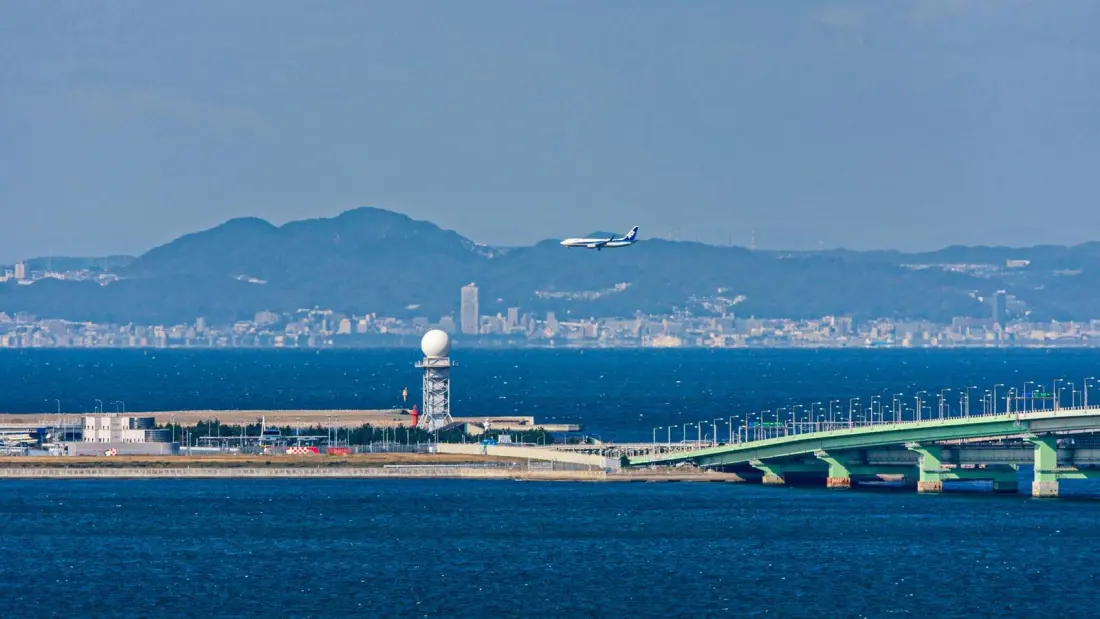
The first and most famous is Japan's Kansai International Airport, opened in 1994 in Osaka Bay and designed by architect Renzo Piano. Built on soft seabed clay, the island required nearly a million sand columns to stabilise it, and it has settled dramatically — around 13 metres in total, though most of that happened during construction. Today it sinks just a few centimetres a year and handles roughly 33.5 million passengers. Its stiffest test came in 2018, when Typhoon Jebi's 110-mph winds pushed a fuel tanker into the only bridge to the mainland, stranding 8,000 people and grounding flights for three weeks.
Japan added a second offshore airport in 2005: Chūbu Centrair, on a D-shaped island in Ise Bay serving Nagoya. The curved design lets bay currents flow around it, and the shoreline uses natural stone slopes instead of concrete walls to encourage seaweed and marine life — there's even a sanctuary inside the island footprint for nesting Little Terns. Before it opened, half of Nagoya's long-haul travellers had to detour through Tokyo; Centrair was fast-tracked to open in time for the 2005 Aichi World Expo.
Hong Kong International at Chek Lap Kok, opened in 1998, may be the boldest of all. Engineers flattened a 100-metre hill with explosives and used the rock to fuse two islands into one 12.5-square-kilometre platform, replacing the infamously tight Kai Tak runway. The overnight switchover in July 1998 was a logistics marvel: convoys of ground equipment crossed the new bridges while about 30 aircraft made short ferry flights from Kai Tak, whose lights went dark for good. The airport now moves around 53 million passengers a year, with a third runway added in 2022 and a terminal expansion due in 2030.
Macau took a leaner approach in 1995, reclaiming only the runway from the Pearl River Estuary while keeping the terminal on Taipa Island. That saved money upfront but now constrains growth, so a major reclamation from 2026 to 2030 will lift annual capacity from 10 million to 13 million passengers.
The newest member of the club is Turkey's Ordu-Giresun Airport on the Black Sea coast, opened in 2015. With the Pontic Mountains leaving no flat ground, builders dumped roughly 35 million tons of rock into the sea across about 950,000 truck trips, ringed by a 4.6-mile breakwater. Passenger numbers jumped over 250% in its first full year and now exceed 1.1 million annually.
Why care? If your trip involves Osaka, Nagoya, Hong Kong, Macau or Turkey's Black Sea coast, there's a decent chance you'll land on ground that didn't exist a few decades ago — and knowing how these places handle typhoons, closures and connections makes for a smarter traveller. Simple Flying compiled the full comparison.