Buying perfume used to be something you did at the airport. Now it's the reason people book flights. 'Perfume tourism' is a real, measurable trend: analysts at Market Intelo project the market will grow from $1.2 billion in 2025 to $2.8 billion by 2034, as travellers build entire itineraries around scent — visiting historic perfumeries, watching fragrances being made, and picking up bottles you literally cannot buy anywhere else.
There's a logic to it beyond shopping. Smell is wired tightly into memory, so a fragrance bought on holiday becomes a souvenir that works: one spritz months later and you're back on that Paris street. Fragrance author Alice Du Parq describes picking up a boutique-only candle at Maison Diptyque on every Paris trip precisely for that reason.
The addresses worth flying for are often mini-museums. In London, Creed's two-floor boutique offers marble-bar consultations with Champagne; Penhaligon's relaunched its Regent Street store in 2025 and sells 155 bespoke Endymion Concentré bottles designed by artist Maggi Hambling; and Floris has traded at 89 Jermyn Street since 1730 — a regular stop for Ian Fleming, still run by the founder's descendants nine generations on. Paris raises the stakes: Guerlain's 1914 Champs-Élysées flagship is a listed monument lined in seventeen types of Carrara marble, Diptyque's original 1961 shop at 34 Boulevard Saint-Germain keeps its archives upstairs and sells a store-only candle called 7 Rue Duphot, and Ex Nihilo's new Rue Saint-Honoré flagship has a device called the Osmologue for personalising scents under expert guidance.
Then there's Grasse in the south of France, Europe's perfumery capital, where three historic houses — Galimard (1747), Molinard (1849, in a building designed by Gustave Eiffel) and Fragonard (1926, with its own museum) — sit within walking distance of each other.
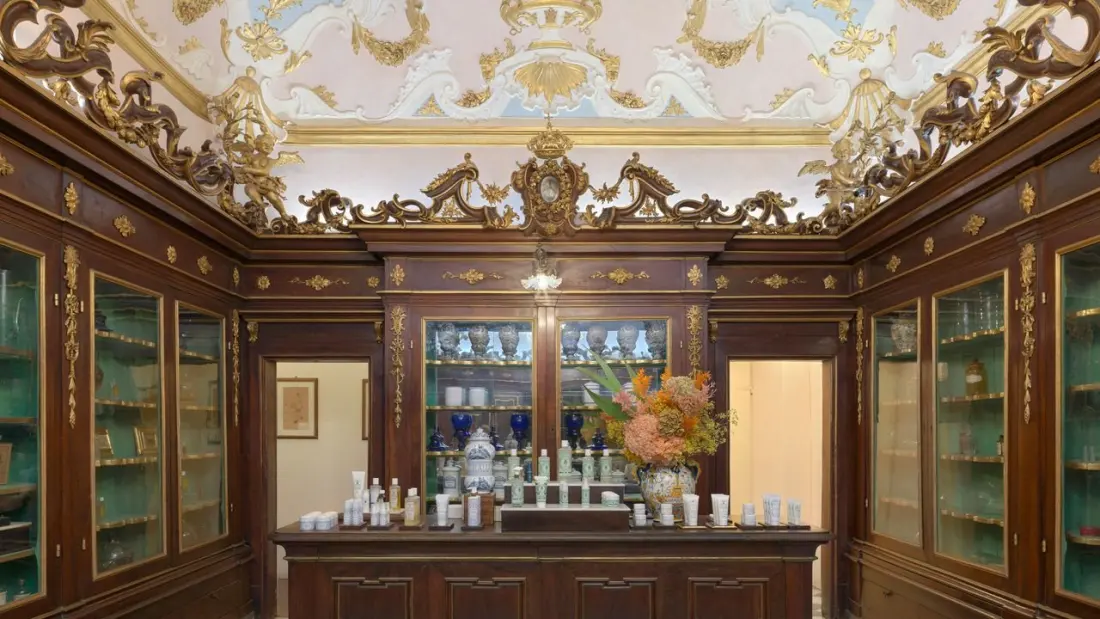
Beyond France and the UK, the list spans continents. Florence's Santa Maria Novella traces its roots to Dominican friars in 1221 and has been open to the public since 1612. Venice's Merchant of Venice occupies a former apothecary redesigned by the architect of La Fenice. New York's C.O. Bigelow has dispensed fragrance from the same Greenwich Village storefront since 1838. In Muscat, Amouage's visitor centre lets you watch distilling behind glass walls and buy Oman-only attars and bukhoors. Beijing's ToSummer converted a 280-year-old courtyard house into a striking flagship, and Rio's Granado, an apothecary since 1870, displays its century-old pharmacy equipment as décor. Berlin scores twice with Byredo's first German store and Escentric Molecules' first-ever boutique on Auguststraße, which doubles as a night-time projection screen.
For a certain kind of traveller — the one who screenshots menus of niche scent houses the way others save restaurant lists — this is a genuinely usable route map. It works as full trips (Grasse, Paris) or as a single memorable hour slotted into a city break, and the store exclusives mean your souvenir won't be sitting on anyone else's shelf at home.