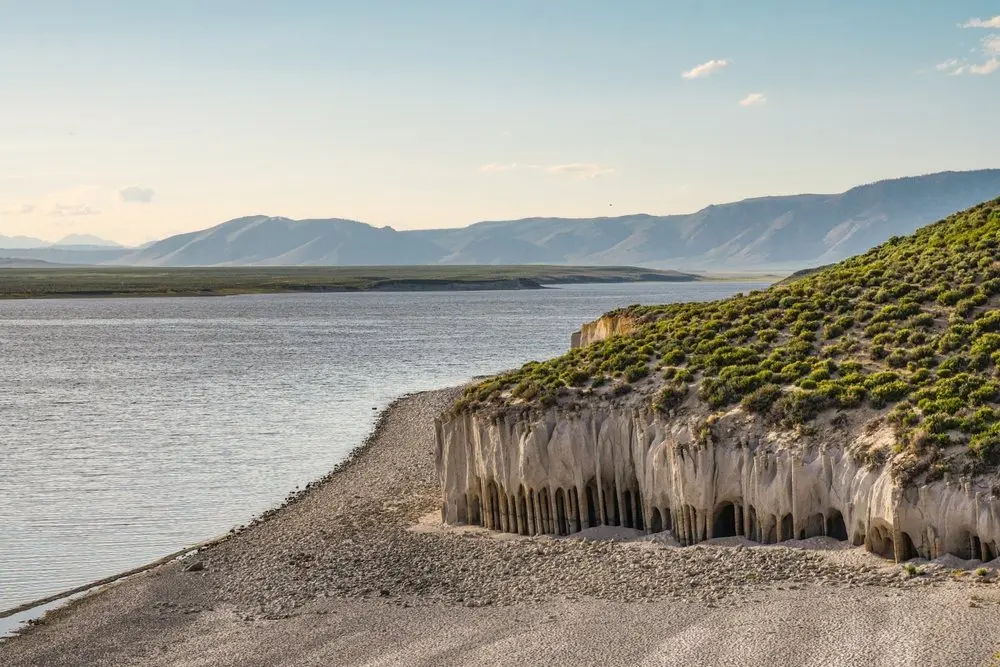
On the eastern shore of Crowley Lake in Mono County, California, hundreds of stone pillars rise up to six metres tall, linked by arches and spaced so evenly that early visitors assumed they were ruins of some ancient temple. Some even compared them to Moorish architecture. In reality, they're entirely natural — and the story behind them is half fire, half water.
The lake itself is a reservoir completed by the Los Angeles Department of Water and Power, named after Father John Crowley, a Catholic priest nicknamed the Desert Padre who championed the area during the water-scarce 1920s and 30s, when Owens Valley water was being diverted to Los Angeles. He pushed tourism as a lifeline for locals, and after his death in a car accident, the Long Valley Dam was finished and the reservoir named in his honour.
The columns only appeared once the reservoir started filling and water levels began their seasonal rise and fall. The repeated soaking and freeze-thaw cycles wore away the soft cliff face, uncovering pillars of Bishop Tuff — compacted volcanic ash from the colossal eruption of the Long Valley Caldera around 760,000 years ago. That blast dumped 650 cubic kilometres of rock and ash, left a depression 32km long and 900m deep, and dropped ash as far away as Kansas.
The formations aren't classic columnar jointing, as many assumed. A UC Berkeley study led by Noah Randolph-Flagg found that rainwater seeped into the still-cooling ash, boiled, and drove steam columns upward, depositing a mineral called mordonite that hardened certain rock sections while the rest eroded away. Remarkably, the whole process took only about a century.
For travellers, the appeal is the solitude. This stretch of the Eastern Sierra draws anglers, kayakers and campers, but the columns remain quiet thanks to their tricky access: on foot, by boat or kayak, or via a steep, rutted dirt road off Highway 395 that can bog down vehicles. Most people drive partway and walk the rest. Visit in low water and you can stroll the shoreline among the pillars; just don't climb on them or push into the shallow caves hollowed into the cliff — the rock isn't as solid as it looks.
The wider area rewards the detour too. The caldera rim holds the Mammoth Lakes cluster and the lava domes of Mammoth, Glass and Bald Mountains, and Highway 395 makes an outstanding road trip corridor. Scientists keep a close watch on the caldera — one of only about 20 supervolcanoes on Earth — and it has shown small quakes and subtle ground movement since the 1980s, though nothing suggesting an imminent eruption.
If you like your natural wonders odd, off-trail and photographable without a crowd, this is one of California's strangest small roadside adventures.