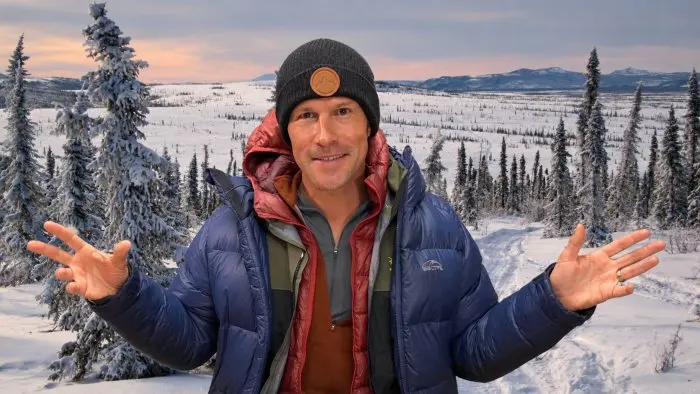
Multi-day winter backpacking has a sneaky enemy: your own sweat. Long-distance hiker Andrew Skurka — known for feats like the 1,400-mile winter snowshoe stretch of the Sea-to-Sea Route through Michigan, Wisconsin and Minnesota, a 380-mile January trek from Duluth to Ely, and an Alaska-Yukon Expedition launched at -15°F in Kotzebue — has a fix worth knowing about: vapor barrier liners, or VBLs.
The problem is physics. When you hike hard in sub-freezing air, moisture moves outward through your clothing until it hits the dew point — which is often inside your insulated jacket, shell or sleeping bag. Unlike a day on the ski slopes, you can't take everything home to dry. Skurka learned this on his first winter thru-hike: after a couple of nights out, his layers and bag were soaked and stayed that way, forcing him to retreat indoors every few days just to reset.
A vapor barrier liner is a deliberately non-breathable layer worn over a thin base layer and under your insulation. Sweat stays next to your skin instead of soaking into your down parka or sleeping bag. Yes, it feels clammy — Skurka admits it takes getting used to — but that clamminess becomes useful feedback. When you notice it, you slow down, shed a layer, or open the vents. Gear like RBH Designs' jackets with full front zips, pit zips and arm zips lets you dump heat without stripping layers entirely.
There's a bonus: VBLs cut evaporative heat loss. Without one, moisture wicking through your layers evaporates near the surface and pulls heat out of your body — the same chill you feel after a sweaty summit push. A liner essentially creates a microclimate that holds warmth in.
Skurka suggests easing in gradually. Start with vapor barrier mitts over a wool liner glove — pop the mitt off and clip it to your shoulder strap when hands get damp. Once daytime highs sit in the teens (°F), add VBL socks: a thin merino liner, the barrier sock, then a thicker oversock for durability inside boots. VBL pants only earn their place when highs are in the single digits, since legs run hot. Gear is niche — look to RBH Designs, Rab (socks) and Western Mountaineering (sleeping bag liners).
One caveat he stresses: all these temperature thresholds flex with sun, wind and terrain. Snow reflects sunlight while dirt absorbs it, so a 20°F day can feel wildly different depending on conditions.
Why should a traveller care? If you're planning a winter hut-to-hut trip, snowshoe expedition, ski tour or any multi-night cold-weather adventure, moisture management is the difference between a comfortable week and a miserable, hypothermia-adjacent one. VBLs aren't for casual weekend trips, but for anyone pushing into genuinely cold backcountry — think consistent daytime highs around 20°F or colder — they can keep sleeping bags lofted, boots wearable and parkas warm for days on end. Treat this as a primer, then test the system on a short overnight before betting a week of your trip on it.