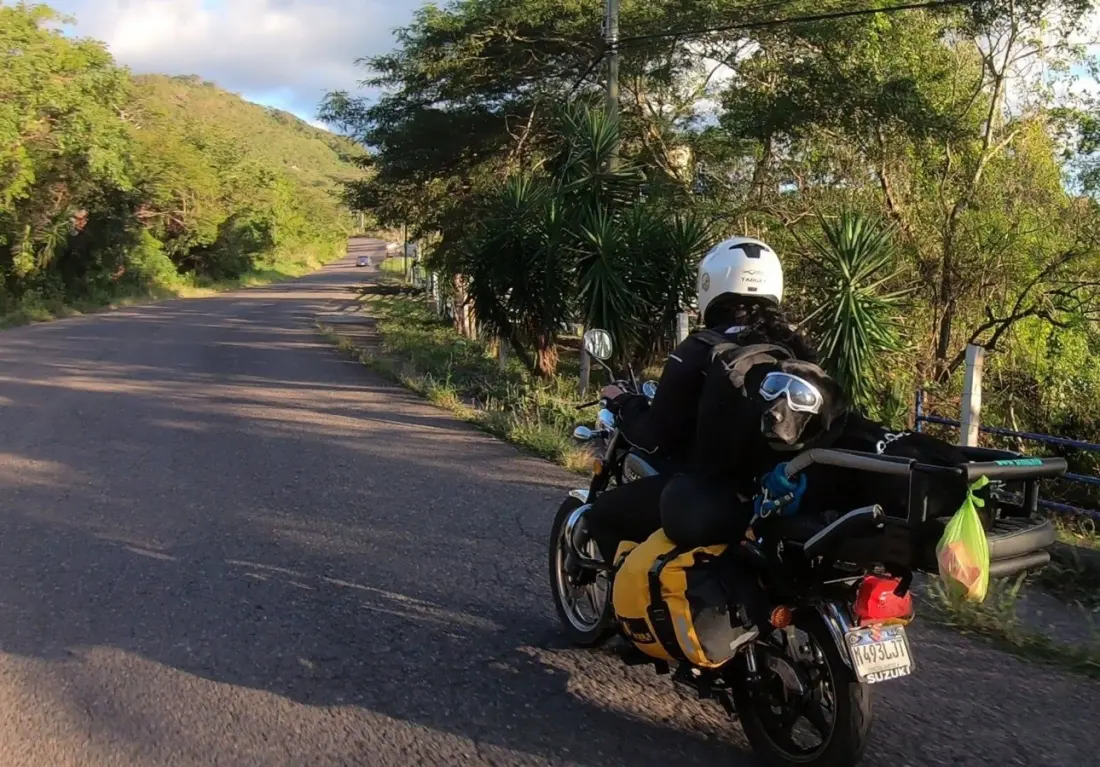
Some people ease into motorcycle touring. One Irish traveller got licensed, flew to Mexico, and rode roughly 10,000km towards Playa del Carmen — with a black Labrador named Gimli riding along. She had never touched a motorbike before deciding the only way to keep her dog on the road was to learn to ride herself.
The trip built on earlier overland experience: she'd already covered a stretch of the Pan-American Highway from Ushuaia to Cartagena, but had to leave Gimli behind. This time she found a dog carrier via the company Dog Bikers, crammed motorcycle training into four months, practised on a heavy Suzuki Bandit, passed her test, and flew to Mexico. Locals in Guatemala told her it was the easiest country for foreigners to buy vehicles, so she picked up a cheap Suzuki GN125 there with help from a notary — the same model she liked so much she bought another one back in Ireland.
The journey had its low points: riding a loaded bike onto a tiny passenger boat across Lake Petén Itzá in Flores, endless mechanical breakdowns, riding through torrential rain, heat, hail and mud, and being hit by a car at a roundabout in El Salvador. The final stretch — three days riding solo to Playa del Carmen after repeated breakdowns, sheltering under a bridge during a storm — was the scariest part. Yet she says she never felt unsafe in El Salvador or Honduras, countries with rough reputations, possibly because everyone was too charmed (or intimidated) by the dog.
The upside? Total freedom. On a bike you can stop at any hidden waterfall or roadside viewpoint you'd otherwise whiz past on a bus — a big deal when travelling with a pet. And the GN125 kept costs low: it's one of the cheapest, most common bikes in the world, so repairs were fast and inexpensive.
Country highlights from the road: Guatemala was affordable and friendly but chaotic — expect bus drivers to overtake aggressively, and cobblestones in colonial towns like Antigua to test your balance. El Salvador surprised her most, emerging as her favourite with its manicured boulevards, surf towns like El Tunco and a coastal road she compares to California's Pacific Coast Highway. Honduras was brief but warm — skip riding through the capital Tegucigalpa at all costs, but consider Comayagua, Lake Yojoa and the dive islands of Roatán and Utila. Nicaragua was the least stressful to ride and packed with underrated, dog-friendly spots, including the Corn Islands off the Caribbean coast. She also spent three months house-sitting in Mérida, Mexico, at the trip's end — a reminder that slow travel fits the region well.
For anyone tempted by something similar: the message is that you don't need to be an expert rider to tour Central America, but you do need patience, basic mechanical resourcefulness and a tolerance for chaos. The reward is a version of the region most bus-bound tourists never see.