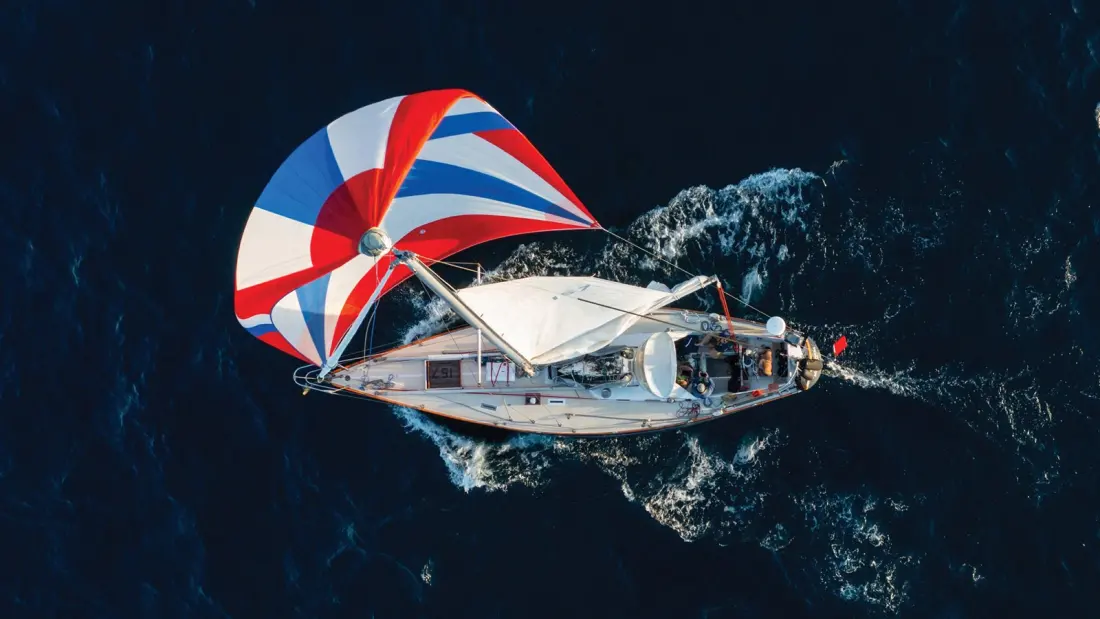
A couple bought a tired 55-year-old yacht off Craigslist, spent eight icy weeks in a Rhode Island boatyard making it seaworthy, and sailed it 2,000-plus miles to Horta in the Azores. Their story is a useful reminder that classic boats and modest budgets can still deliver serious offshore adventures.
Georgie Holman and her partner Jasper had spent four years running a Fife yawl in the Pacific before deciding to find a boat of their own. The brief: strong, capable offshore, beautiful lines, proven pedigree — with space and modern comforts sacrificed willingly. A friend's tip-off led them to a 1971 Swan 43 designed by Sparkman & Stephens, ashore in Rhode Island. Maru Noa had been out of the water for around four years and barely sailed in a decade, but she was fundamentally sound and came with a brand new engine.
The refit window was tight. They arrived in early March, when the yard was a frozen wasteland, lived aboard with an electric radiator and hot water bottles, and rationed themselves to three nights in a B&B before a trip to Ikea for bedding and galley basics. Over six weeks they focused ruthlessly on essentials: through-hulls, partial rewiring, new batteries, plumbing, engine checks, rebedded hatches, a Hydrovane wind vane and antifouling. Function over perfection — the plan was a proper refit later, back home in Cornwall. They launched a week ahead of schedule.
They slipped from Newport on 2 May with Jasper's father Tino and friend James aboard, and the Swan quickly showed why the model has such a reputation, holding 7-8 knots on a fast reach. The crossing delivered the full Atlantic experience: dolphins carving through bioluminescence at night, a humpback breaching off the stern, then a gale that found every deck leak they'd missed. The Hydrovane failed mid-ocean when a set screw worked loose — fixed with hose clamps and rope while hanging off the stern, with the Hydrovane team diagnosing the fault over Starlink and shipping spares to Horta. Days of hard windward work through the Gulf Stream tested everyone, before conditions eased, an albacore tuna became poke bowls, and Flores rose on the horizon on day twelve. They anchored off Horta just after 2.30am, thirteen days after leaving Rhode Island.
Why should a traveller care? Because Horta remains one of the great waypoints of Atlantic sailing, and this account demystifies the route from New England to the Azores — a realistic, affordable path for anyone dreaming of an ocean crossing. It also shows what patient second-hand boat hunting can yield, and that landfall by night, anchoring beneath a dark volcanic silhouette, is worth every cold watch.