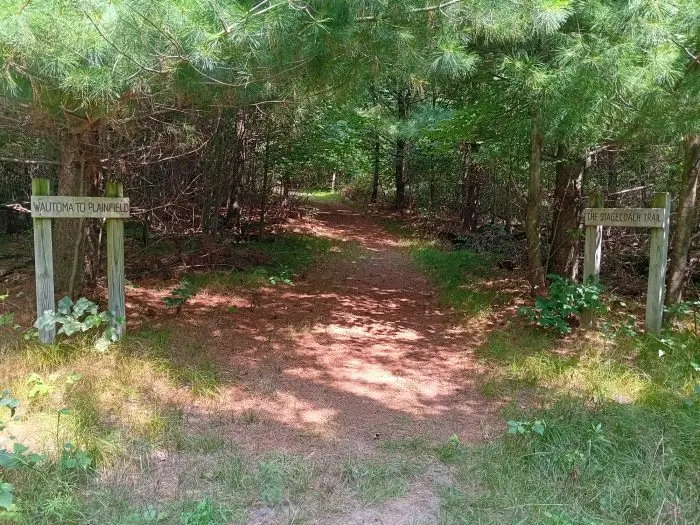
Long-distance hiking in Wisconsin isn't all forest path. Just ask the thru-hiker who recently logged the Ice Age Trail's central stretch — a 400-mile band of the route criss-crossed with so-called Connecting Routes, essentially road walks that link the trail segments. Three-plus weeks in, they were covering anything from 13-mile easy days to a single 30-miler, and learning the fine art of camping wherever the map allows.
The road miles come with quirks. The writer, who has now walked roughly 500 miles of these connectors, reports that almost all Wisconsin drivers politely swing fully into the opposite lane to pass a hiker — a few even stop dead when oncoming traffic blocks the manoeuvre. The odd exceptions: phone-gazing drivers and vehicles passing within feet from behind. There's also a less obvious hazard — centre-pivot irrigation sprinklers that overshoot their fields and soak the road edge, demanding well-timed sprints.
The towns are the reward. Antigo delivered an ice cream stop, a classic car show blocking four blocks of Fifth Avenue, a diner lunch, and free phone charging and water at Jaycee Park — plus a two-foot turtle in the brook for good measure. Hatley offered a library bench, a shaded pavilion, resupply at Dollar General and lunch at the town's only bar. Convenience stores and gas stations pepper this central region, making food logistics far easier than in true backcountry — though the writer admits to 'backcountry mode' lapses, like seriously considering a roadside bag of found Lifesavers.
Camping is the real puzzle. When Hartman Creek State Park's concession stand was shut (an E. coli closure at Hartman Lake), the workaround was a tent, shower, laundry and a campfire from trimmed brush left at the site. At Bohn Lake, the flat spots touted in the FarOut app didn't materialise, a plan to pitch in the parking lot failed because visitors kept arriving, and the night ended at a nearby trail area where camping wasn't explicitly banned — close enough. Elsewhere, a volunteer-built shelter with lights and power outlets felt downright luxurious.
Then there's the weather. A 5 AM storm brought 90 minutes of building thunder, a soggy pack-up and a slow drying-out morning along the Mecan River. Days later, a second system chased boats off Pleasant Lake while the hiker sheltered under a pavilion — noting that a metal roof with no walls is a questionable lightning plan. A shortcut shaved the official route and got the tent up before the next cell arrived.
Why care? The Ice Age Trail is one of America's newer National Scenic Trails and remains far quieter than the Appalachian or Pacific Crest routes. This central section suits hikers who like daily variety, small-town resupply and the flexibility to improvise camps — and don't mind sharing the road with pickups.