
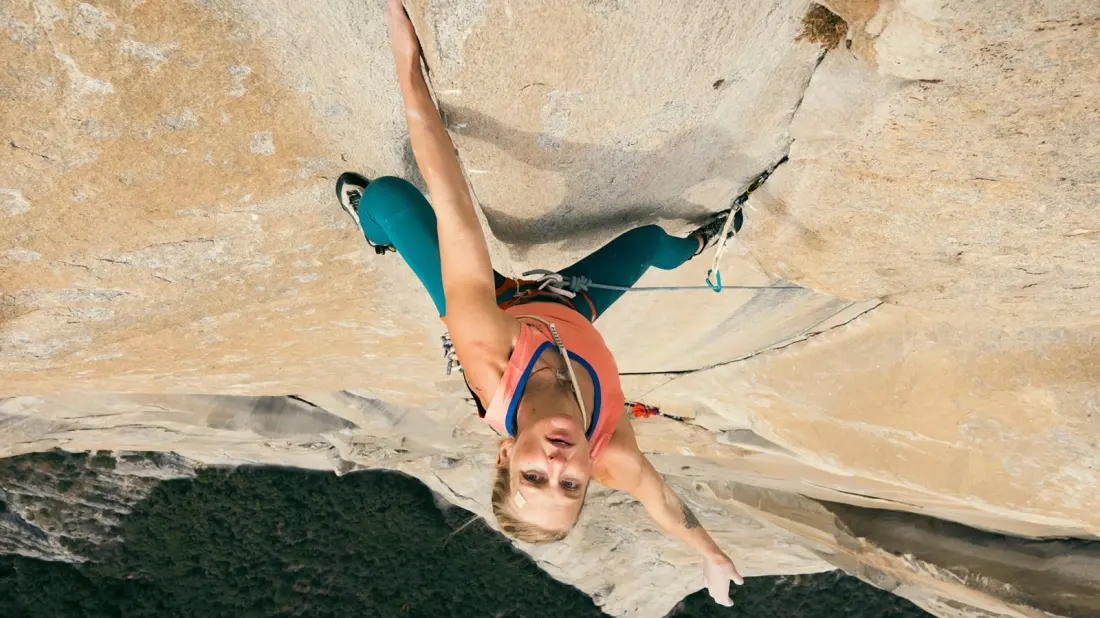
On September 16, Netflix adds Girl Climber to its line-up, giving a wide audience a documentary that already picked up multiple awards on the mountain-film festival circuit after its 2025 debut. The film follows American climber Emily Harrington through her multi-year battle to free climb El Capitan's Golden Gate route in Yosemite within 24 hours — a feat only three men had ever managed before her.
The route is serious business: 3,200 feet of granite, 36 pitches of demanding technical climbing. Harrington, who won five US national championships as an indoor competition climber before summiting Everest in 2012, first set her sights on the goal in 2018 at age 33. The attempts pile up on camera — turned back by weather, exhaustion, one run ending just 300 feet short of the summit, and a violent fall that put her in hospital. She finally nailed it on November 4, 2020, in 21 hours, 13 minutes and 51 seconds, taking another hard fall en route that opened a deep gash on her forehead.
What makes the film more than a climbing reel is its second ticking clock. Harrington was, by her own admission, weighing the project against her desire to start a family with her partner, high-altitude guide Adrian Ballinger. Each failed attempt raised a question most sports documentaries never ask: whether walking away might be the smarter call. Interviews with Lynn Hill, Tommy Caldwell and Alex Honnold — Harrington's partner on the ascent — frame how male-dominated El Cap's record books have been.
The epilogue complicates the triumph further. Harrington reflects on the death of her friend and mentor Hilaree Nelson, who died in September 2022 at 49 while skiing down Manaslu in Nepal after summiting, leaving two children behind. Between Nelson's death, Harrington's injuries and her move into motherhood, the film pointedly declines to answer whether it was all worth it — and Harrington admits in interviews that finishing Golden Gate didn't quiet the drive, it just made her more balanced about it. She's now chipping away at a long-standing 5.14 project near her home in Tahoe and climbing bigger multi-pitch routes in the Eastern Sierra.
For travellers, it's a reason to look at Yosemite with fresh eyes — not just as a postcard valley but as the arena for one of the great sporting stories of the decade, told with a honesty rare in adventure film. It also lands well beyond the climbing crowd: Harrington's point is that fear, failure and life transitions are universal, and that women who become mothers don't owe anyone an exit from the outdoors. If Free Solo taught the public that climbers rope up, this one shows what partnership, obsession and reinvention actually look like on the wall.