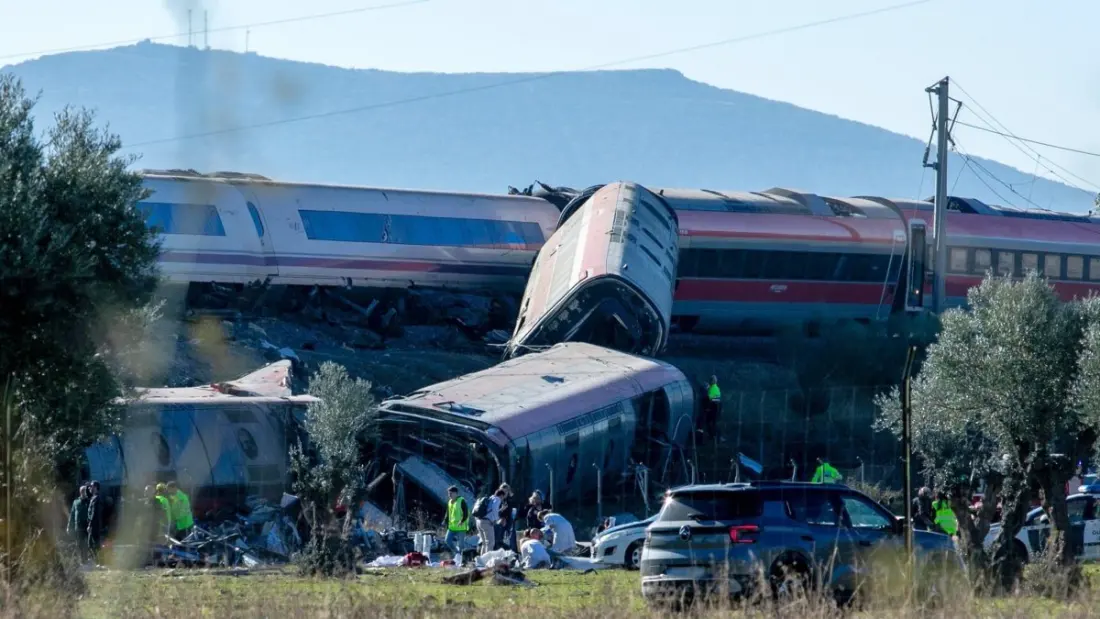
Two high-speed trains collided in central Spain on Wednesday morning, killing at least 10 people and halting rail traffic on one of the country's busiest routes. Authorities have warned the death toll may rise as rescue work continues.
The crash happened shortly after 9 a.m. near the towns of Mora and Orgaz in Toledo province, on the high-speed line connecting Madrid with Seville. A train operated by state-owned Renfe struck the rear of a stationary Iryo service, run by the private operator, knocking two of the Iryo carriages off the tracks. The cause is not yet known and investigators have only just begun their work.
Both trains were packed. The Renfe service had 397 people on board, the Iryo train 147 — more than 540 passengers in total. Emergency crews were deployed to the scene, and in nearby Urda the town hall was asked to open a sports pavilion to shelter affected passengers. Castilla-La Mancha's regional president Emiliano Garcia-Page travelled to the site, while regional spokeswoman Esther Padilla confirmed the initial figure of 10 dead.
Spain's rail infrastructure operator ADIF suspended traffic on the Madrid–Andalusia high-speed line, disrupting services between Madrid, Ciudad Real and the south. Travellers with bookings on that corridor in the coming days should expect delays, cancellations or replacement arrangements and check directly with Renfe or Iryo before setting out.
The collision is the second major rail disaster in Spain this year. In January, 46 people died when a train derailed near Adamuz in Cordoba province and hit an oncoming train — the country's deadliest rail accident since the 2013 Santiago de Compostela derailment that killed 80. Two fatal crashes in under a year will inevitably put pressure on questions about safety across Spain's extensive high-speed network, which millions of visitors use every year to hop between Madrid, Seville, Cordoba and Malaga.
For anyone planning rail travel in Spain right now, the practical takeaway is simple: the Madrid–Andalusia corridor is disrupted indefinitely, so verify schedules before travelling and consider alternative routes or bus and air connections if your trip is time-sensitive. Beyond the immediate disruption, the back-to-back disasters may lead to stricter safety checks and further delays across the network in the weeks ahead.
Reporting by Daily Sabah Travel