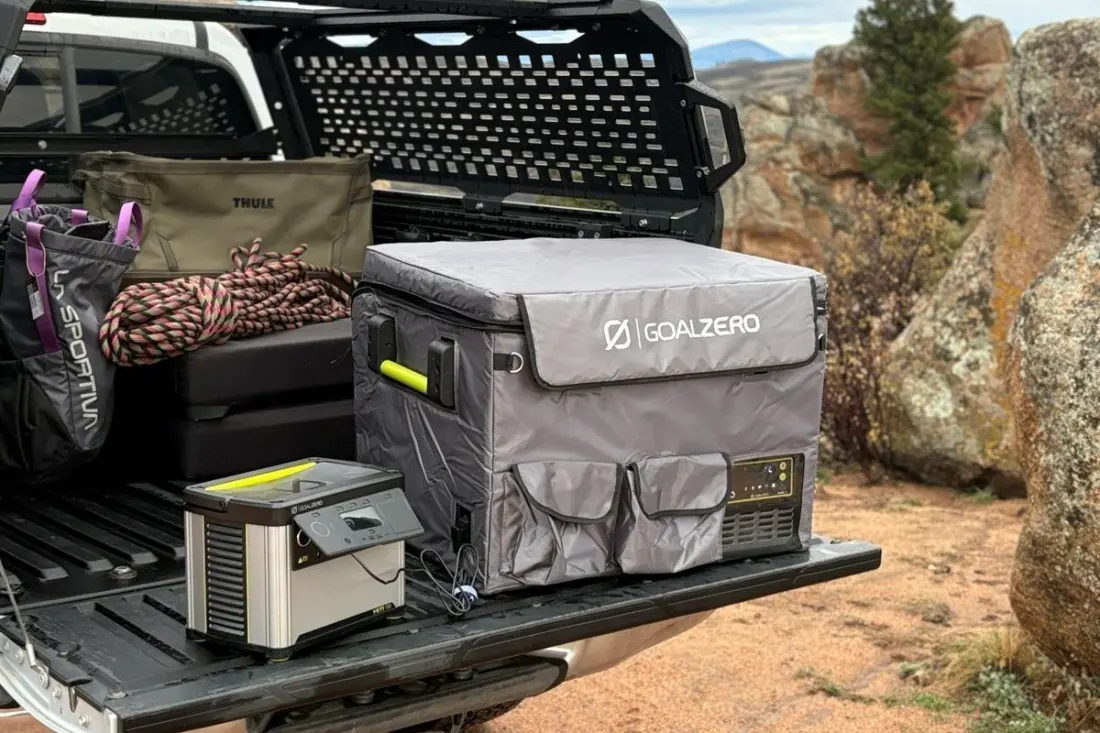
Anyone who has pulled a soggy sandwich out of a puddle of meltwater at a campsite knows the limits of the humble ice cooler. Alpinist's reviewer spent eight weeks testing Goal Zero's three-piece solar fridge setup — the Alta 50 electric cooler, Yeti 700 power station and Nomad 100 solar panel — and came away convinced this is the one upgrade worth making to a car-camping rig.
The bundle costs $1,749.90 at MSRP (versus $1,899.85 if bought separately) and everything plugs together with included cables, so there's no guesswork. Setup took under 10 minutes. The Yeti 700 ($699.95, 20.3 pounds) stores 677 watt-hours in a lithium iron phosphate battery rated for 4,000 cycles — more than a decade of daily use — in a rugged, IPX4 weather-resistant case. It puts out 600 watts continuous through two AC outlets, plus a spread of USB-C, USB-A and 12-volt ports, enough to run an induction cooktop or kettle alongside the fridge.
The Alta 50 ($799.95, 49.4 pounds) is the catch: it works as a fridge or a freezer, but not both at once, since it's a single 52.6-liter compartment holding roughly 75 cans. Temperatures run from -4 to 68°F, it cooled from 75 to 35 degrees in about half an hour in testing, and an LG compressor keeps it efficient at around 8 watts average. Two caveats: it's heavy enough to be a two-person lift when full, and there are no wheels.
The Nomad 100 panel ($399.95, 10.2 pounds) folds up with magnets and kickstands, and delivered a realistic 85-90 watts in good sun. In summer conditions in the Colorado mountains — highs near 75, cool nights, sunny skies — the system essentially ran forever: the fridge drained the battery about 15% overnight, and a few hours of sunshine topped it back to 100%. Goal Zero says the Yeti alone can run the fridge for over three days without any solar input, so three straight days of heavy clouds is the real risk. A $24.95 cable lets you recharge from the car in about six hours as a backup.
The pitch is simple: no ice to buy, no meltwater to drain, no waterlogged food, and a temperature that holds steady instead of climbing as the ice melts. For road trippers, overlanders and anyone setting up base camp from a vehicle, the reviewer calls it a worthy investment — provided you can stomach the price, which rivals a high-end conventional cooler several times over. Everything is app-controlled via Bluetooth, and the power station remains useful for charging devices even when the fridge stays home.