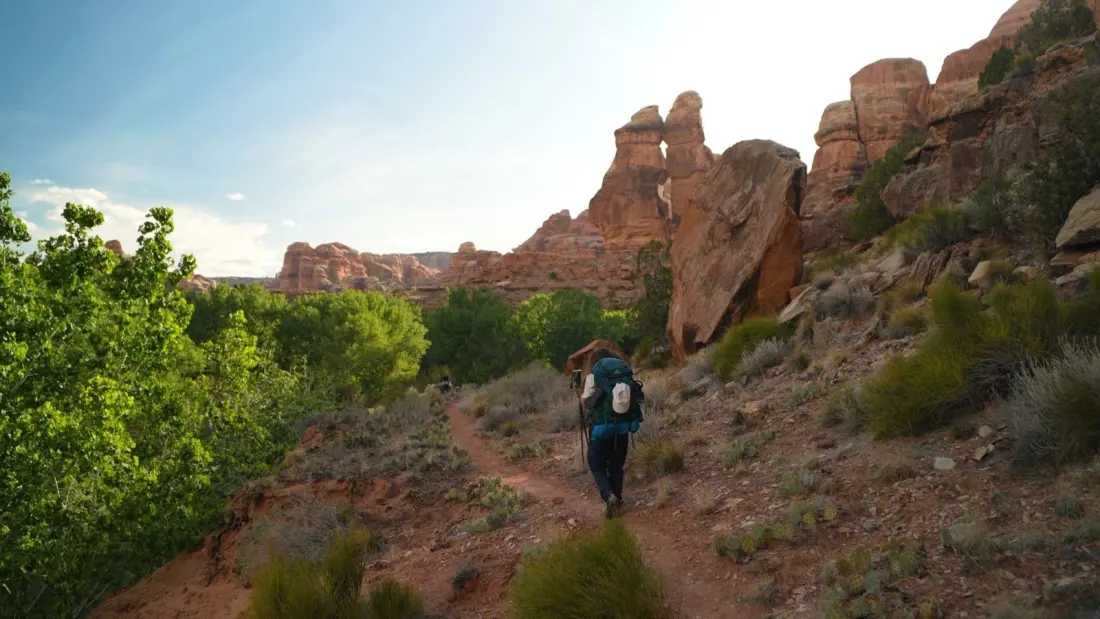
There's a canyon in Canyonlands National Park where a nearly life-size figure painted in red, white and blue has watched over the sandstone for centuries. Radiocarbon testing pegs it to around the 14th century — and it's just one highlight on a 30-mile backpacking route that reads like a walk-through history book.
The route runs point-to-point from Cathedral Butte near the edge of Bears Ears National Monument down to Salt Creek Gate, a little over 30 miles with modest elevation loss — the trail starts high and mostly heads down. Don't let the downhill profile fool you, though: long stretches of deep sand make this a genuinely demanding two-day hike, and a vehicle shuttle is essential.
What makes Salt Creek special is the density of human history layered along the way. About two miles in, you pass Kirk Spring, a green oasis ringed by cottonwoods, and Kirk's Cabin, an 1890s log homestead complete with fieldstone chimney, bear traps and old wagon axles. Around mile six, a short spur leads to Ancestral Puebloan granaries tucked under a sandstone overhang, with squash vines still growing in the shade below.
Then comes the headliner. Around mile eight, hidden high in an alcove, sits the All American Man — a striking pictograph of a human-like figure in blue, white and red, wearing what looks like white boots, a headdress and a flag-like design. For years people doubted its age until radiocarbon dating confirmed its 14th-century origins. Not far beyond, the Four Faces Spring panel features four enormous, intricately patterned faces whose meaning remains a mystery. Farther down the canyon, the Flying Carpet Panel adds yet more large-scale ancient artwork.
The detour most hikers shouldn't skip: Angel Arch, several miles up a side canyon. Its sandstone span rises roughly 135 feet, with a formation beside it resembling a winged angel — a sight that rivals anything in neighbouring Arches National Park, made sweeter by the fact that you'll likely have it entirely to yourself. The author didn't see a single other hiker over two days.
Practical notes worth heeding: overnight permits are required, water is seasonal and never guaranteed despite the surprisingly lush creek corridor (sources thin out as you descend), and the willow-and-cottonwood sections breed serious mosquito clouds, so pack repellent. The final miles follow a sandy four-wheel-drive road to the gate — tiring, but a small price for a canyon this rich.
Why go? Because Salt Creek compresses everything people love about southern Utah — red rock, arches, springs, solitude — plus some of the finest pictographs in the Southwest, all in one quiet corridor. It suits fit backpackers comfortable with sand, shuttles and self-sufficiency, and anyone who'd rather earn their museum than queue for one. Visit with respect: this remains a living cultural landscape for Indigenous communities, and the art is irreplaceable.
Story via Backpacker.