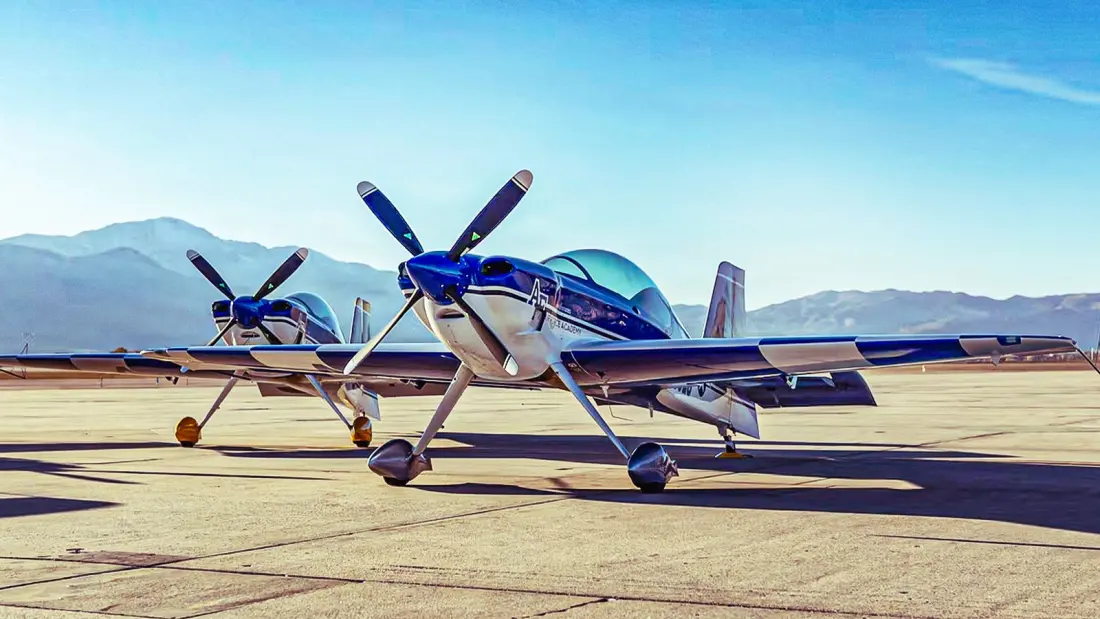
Four sleek carbon-fibre aircraft swept low over the Cadet Wing at the US Air Force Academy on November 12, marking the official arrival of the T-19A Kestrel at Davis Airfield in Colorado Springs. What makes the delivery remarkable isn't just the aircraft itself — it's how fast it got there. Rather than the usual decade-long defense procurement slog, the Academy fielded its new unlimited aerobatic trainer in just 10 months, funded largely by $3 million in private donations coordinated by philanthropist Andrew McKenna, with USAFA adding $400,000 for tooling, spares and flight gear.
The Kestrel is a military version of the civilian GB1 GameBird, designed by German aerobatic champion Philipp Steinbach and built by Game Aerospace Composites in Bentonville, Arkansas. It's the only American-built two-seater certified for Unlimited-category competition aerobatics, and the numbers are eye-catching: a 1,290-pound empty weight thanks to an autoclave-cured carbon monocoque with no traditional wing joints, a 303-horsepower Lycoming flat-six with inverted oil and fuel systems, and certification to pull a full 10 G in either direction. It rolls at 400 degrees per second — more than double the Air Force's T-6A Texan II — and can take off in just 680 feet.
For cadets, the aircraft fills an awkward gap. The Academy's existing fleet jumps from unpowered gliders and basic piston trainers straight to the turboprops of Undergraduate Pilot Training. Standard trainers are built for stability and ban extreme manoeuvres, so cadets never see inverted spins or vertical stalls until they're deep in the pipeline. The Kestrel lets instructors deliberately put students into disorienting attitudes and teach instinctive recovery skills — exactly the kind of training that prevents real-world loss-of-control accidents. Six instructor pilots from the 306th Flying Training Group are now building the syllabus, and plans include a cadet aerobatic demonstration and competition team.
The urgency is practical: the Air Force is short roughly 2,000 operational pilots, so producing cadets who arrive at pilot training already sharp on stick-and-rudder skills saves remedial flights and speeds up the whole pipeline.
Operating at Colorado Springs isn't trivial, though. Davis Airfield sits at 6,572 feet, and summer heat can make the air feel like it's above 9,000 feet, sapping the non-turbocharged engine of up to a quarter of its power. Weight limits bite too — at the 1,940-pound aerobatic maximum, a crew of two leaves room for only 25 to 30 gallons of fuel, capping intense sorties at around 45 minutes. Ground crews will need fast turnarounds between flights.
For travellers, this is a story worth watching if you're heading to Colorado Springs. The Academy's visitor centre already draws aviation fans to watch cadet glider and jump operations over the Rampart Range, and a new cadet aerobatic team would add a genuine airshow draw to the Front Range — a region that also serves as the gateway to Garden of the Gods, Pikes Peak and the US Olympic & Paralympic Training Center.