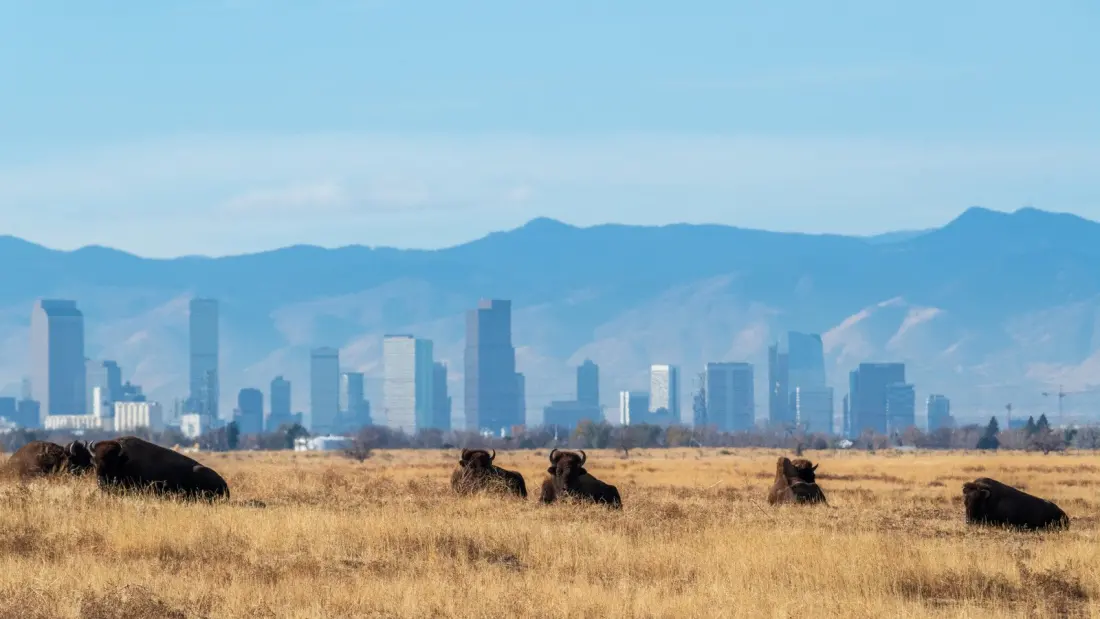
Ten minutes from downtown Denver, on a site that once manufactured chemical weapons, bison now roam free. The Rocky Mountain Arsenal National Wildlife Refuge is one of America's great adaptive reuse stories — a 15,000-acre reserve wedged between the city and Denver International Airport, where prairie, lakes and wildflower fields have replaced a WWII-era Army munitions plant.
The history is stranger than fiction. Built after Pearl Harbor to produce chemical weapons, the site kept churning out agricultural chemicals and Cold War armaments for decades. Then, in the late 1980s, bald eagles were found nesting there. That discovery led to a handover to the U.S. Fish and Wildlife Service, a massive environmental cleanup, and a refuge designation in 1992 — though the full transition only wrapped up in 2004.
The star attraction today is the free 11-mile wildlife drive, a loop through open prairie and around lakes with Denver's skyline as a backdrop. It's the easiest place in America to feel like you're on safari without leaving a metro area: the bison herd reintroduced in 2007, plus deer, coyotes, prairie dogs and black-footed ferrets. Birdwatchers do particularly well here, and the light at sunrise and sunset — when the refuge opens and closes most days of the year — is worth planning around.
You don't have to stay in the car. Around 20 miles of well-marked hiking trails crisscross the reserve, and the Discovery Trail is the spot to look for black-footed ferrets, among North America's most endangered mammals. Cyclists can share many of the routes. Anglers get catch-and-release fishing on Lake Mary and Lake Ladora from April to November, with pike, bass, bluegill, catfish, crappie and yellow perch on the cards. There's a 15-lane archery range, and families can tap into free ranger-led programs where kids earn Junior Ranger badges.
Winter doesn't shut the place down either. Denver is a popular cold-season city break, and the refuge doubles as an unlikely snow-sports spot — snowshoeing and cross-country skiing are both allowed once the trails are blanketed, with that surreal city-on-the-horizon view thrown in.
For travellers, the appeal is obvious: it's free, minutes from downtown, and open nearly every day. If you're flying into or out of DEN, it sits conveniently on that side of town — an easy pre-flight nature stop. It pairs naturally with a Denver city stay, a Red Rocks day trip, or a longer Colorado Rockies road trip, and it's one of the cheapest, most accessible wildlife experiences you'll find anywhere in the U.S.
Story via Explore.com.