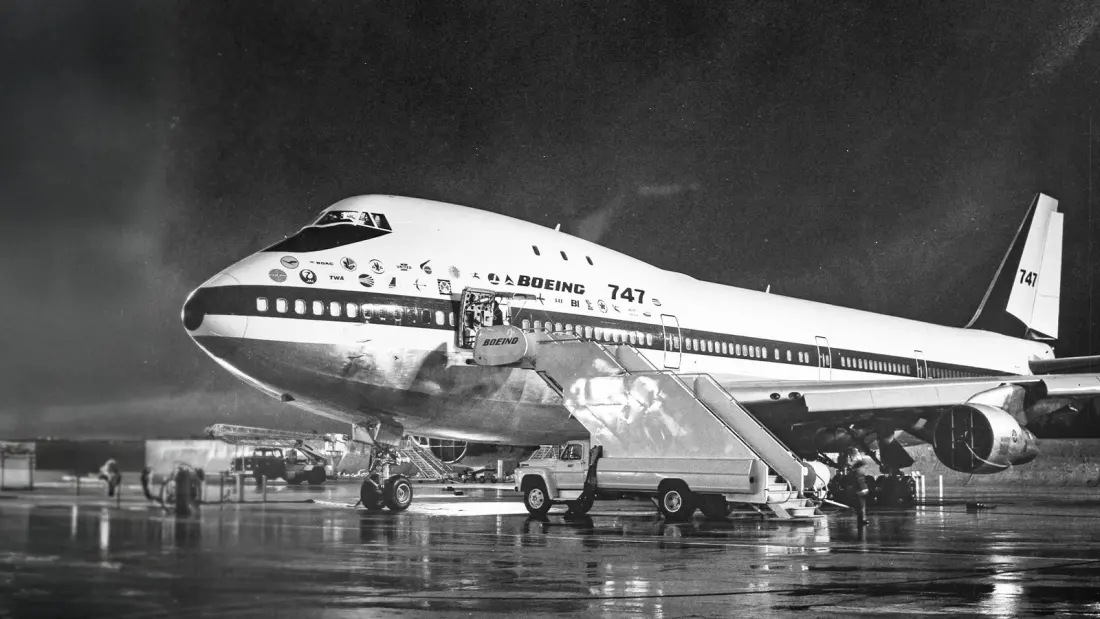
The Boeing 747 went from an announcement to a finished aircraft in 29 months. Boeing confirmed the project on April 13, 1966, and the first 747-100 rolled out of a brand-new factory in Everett, Washington, on September 30, 1968. Its maiden flight followed on February 9, 1969, and paying passengers were on board by January 1970. Concept to service in under four years — a pace no widebody program has matched since.
The push came from Pan Am. Its boss, Juan Trippe, had spent years trying to make flying affordable for ordinary people (he introduced the world's first economy fare in 1958) and wanted a jet two and a half times bigger than the 707. His pitch to Boeing president William Allen was famously blunt: "If you'll build it, I'll buy it." The resulting deal — 25 aircraft for $525 million, roughly $5.5 billion today — set a punishing 1969 delivery deadline.
Boeing had useful groundwork. It had lost a 1965 military transport contest to Lockheed's C-5 Galaxy, but the research fed into the high-bypass engines and the distinctive hump that lets the 747 double as a freighter. Engineer Joe Sutter, later called the Father of the 747, led a team that swelled from a few hundred to 4,500 almost overnight, part of a workforce of about 50,000 that would eventually touch the program. At one point, with Boeing drowning in debt and no government backstop, Sutter was told to cut engineers — he asked for hundreds more instead, convinced he was signing his own dismissal. Nobody fired him, and the gamble paid off.
The logistics were just as wild. There was no factory big enough, so Boeing cleared forest near Everett in 1967 and built one while the first aircraft was already being assembled inside the unfinished building. That facility remains the largest building in the world by volume, and it turned out 1,574 jumbos before the last 747-8 freighter went to Atlas Air in 2023.
For contrast: Airbus needed five years just to get the A380 from launch to prototype, and its first delivery came in 2007. Boeing's own 777 took three and a half years to prototype; the 777X, launched in 2013, still hasn't been certified. The 747's speed was a one-off — and a risky one. The Pan Am contract covered barely half the program's $1 billion cost, but it opened up long-haul flying to the masses and shaped the holiday industry we know today.
For travellers, it's a reminder that the affordable long-haul trip started here: a huge, efficient jet that let airlines drop fares and fill seats across oceans. The last 747s are still flying with passengers on carriers like Lufthansa and Korean Air, so aviation fans can still book a seat on the upper deck of a genuine Queen of the Skies before they're gone for good.