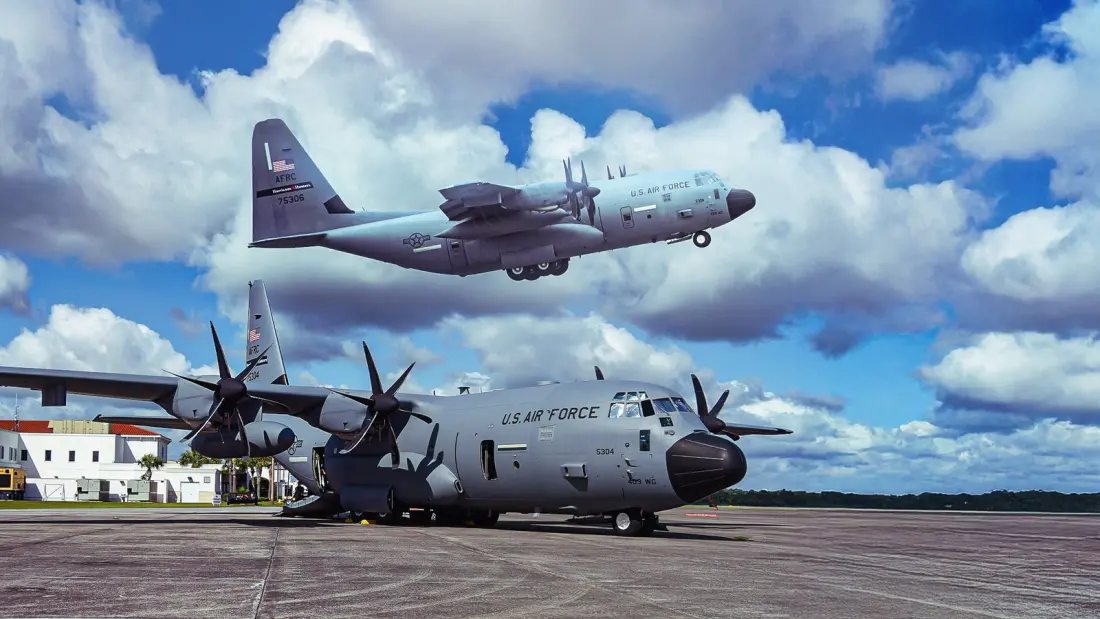
Three military aircraft recently flew straight into a tropical storm near Hawaii, and anyone with a flight-tracking app could watch every second of it. On August 10, 2026, three WC-130J Super Hercules from the 53rd Weather Reconnaissance Squadron — the Air Force Reserve unit known as the Hurricane Hunters — left Keesler Air Force Base in Biloxi, Mississippi, and headed west to intercept Tropical Storm Lala in the Central Pacific. Over three days, from August 12 to 14, the crews flew repeated passes through the storm at around 10,000 feet, releasing instruments to measure what satellites cannot see.
The trick to spotting them on a flight tracker is their call signs. The aircraft fly as TEAL81, TEAL82 and TEAL83, and their ADS-B transponders make them visible on public tracking platforms throughout hurricane season, which runs June 1 to November 30 in the Atlantic and Central Pacific. Once a plane reaches a storm, it's unmistakable: instead of a straight route, it flies through the eyewall, into the eye, out the other side, then back through on a perpendicular heading. The result is a distinctive cross shape centred on the storm — nothing else in the sky looks like it.
The squadron is the only Department of Defense unit still flying into tropical cyclones, a mission that dates to 1944, when a pilot flew into a hurricane on a dare. Today it operates ten modified C-130Js from Biloxi, each crewed by five people, including an aerial reconnaissance weather officer who relays data to the National Hurricane Center in Miami. The key tool is the dropsonde, a tube-sized instrument dropped on a parachute that measures wind, pressure, temperature and humidity from flight level all the way to the ocean surface. According to the NHC, this data improves forecast accuracy by up to 20% — a big deal in the data-sparse Central Pacific, where few weather stations and airline routes exist to fill the gaps.
During the Lala deployment, the crews operated from the Big Island near Kona, and the storm they were measuring strengthened into a Category 1 hurricane as it approached the Hawaiian Islands. The squadron also flies winter missions at 30,000 feet to study atmospheric rivers heading for the US West Coast. And while flying into a hurricane sounds reckless, the aircraft are reinforced cargo planes built for it; the crews describe the work as methodical rather than dramatic. Pilot Maj. Sarah Olson noted that the crew first pinpoints the storm's centre by analysing the winds, then makes more passes to track its movement — the ground truth that forecast models need to issue the evacuation guidance that matters to coastal communities.
For travellers, the appeal is simple: hurricane season becomes something you can follow rather than just fear. If a tropical system is brewing near your holiday destination, searching TEAL call signs on a live tracker shows you the actual reconnaissance effort underway — and the cross-shaped flight paths are one of aviation's more peculiar free spectacles.