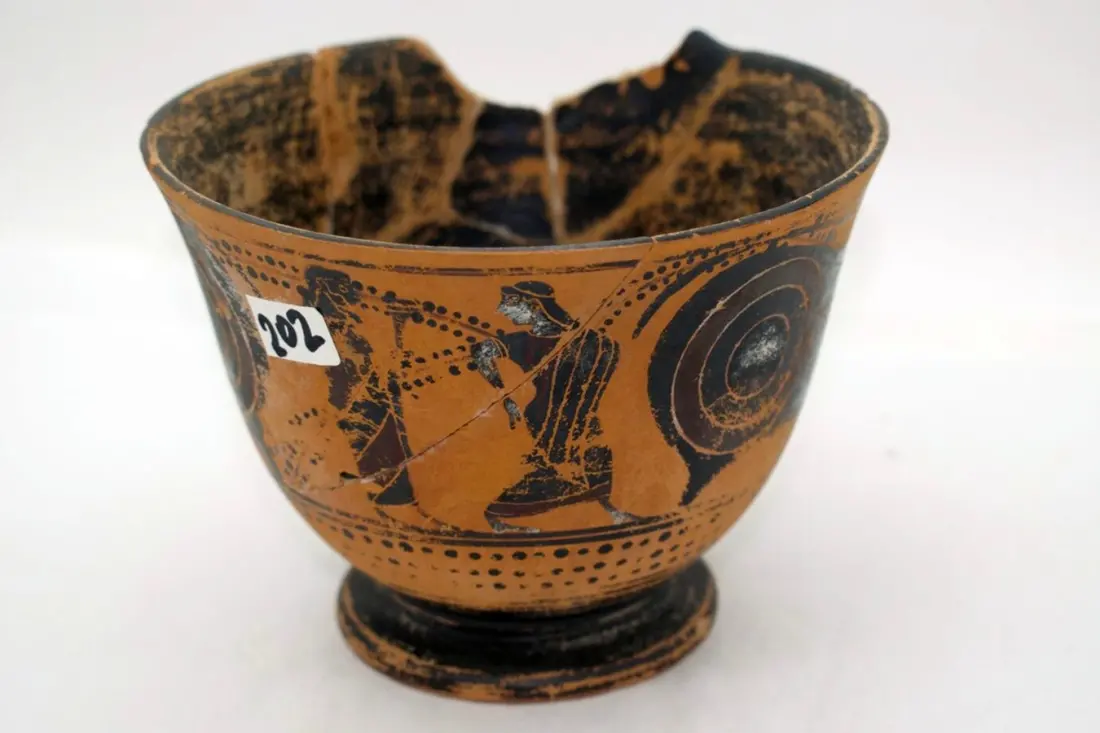
Twenty-two ancient Greek objects, seized from suspected antiquities traffickers in Israel six years ago, are finally back in Athens. The handover took place on 13 October 2026 at the National Archaeological Museum, where Israeli Ambassador Pninat Yanay formally presented the pieces to Greek Culture Minister Lina Mendoni. It is the first time Israel has ever repatriated archaeological objects to Greece.
The collection is a compact tour of ancient Greek pottery traditions. Fifteen vessels come from Attic workshops around Athens — 11 black-figure pieces, three red-figure and one black-glazed — while six others originated in Corinth, dating to the Archaic period. The pieces span roughly 700 to 320 B.C., covering both the Archaic and Classical eras. There is also a small bronze statuette of a female figure, though Greek officials say it still needs testing before its authenticity can be confirmed.
For the uninitiated: black-figure pottery shows dark figures painted on the clay's natural red surface with details cut into the decoration, while red-figure flips the scheme, leaving figures in the clay's own colour against a dark background. These vessels weren't just art objects. They held oils and drinks, featured in religious ceremonies, and some ended up in graves as funerary offerings, decorated with mythological scenes and geometric patterns.
The road home started with a 2020 investigation run jointly by the Israel Antiquities Authority, Israel Police and the Israel Tax Authority. Searches at a gallery, warehouses and apartments across the Greater Tel Aviv area turned up thousands of artefacts from Israel and beyond. The 22 Greek pieces were confiscated through legal proceedings and identified for return. What officials haven't explained is how the objects originally left Greece, who took them or how they moved through the market — so the full smuggling story remains untold.
The restitution is also a diplomatic signal. Mendoni framed it as the start of deeper cooperation on protecting cultural property, and there's already substance behind the words: Israel's antiquities theft-prevention unit and Greece's antiquities police joined an international enforcement workshop in September 2025, swapping intelligence on looted objects and smuggling routes. A bilateral memorandum of understanding on heritage protection is reportedly in the works, building on talks between Mendoni and Israeli Culture Minister Miki Zohar in Jerusalem in March 2025.
Why should a traveller care? Two reasons. First, if you're visiting Athens, the National Archaeological Museum remains the best single place in the world to read ancient Greek pottery in sequence — black-figure to red-figure, myth to daily life — and restituted pieces like these often end up on display. Second, the story is a reminder that the antiquities you see in any museum have histories, sometimes murky ones. The push to trace looted objects is reshaping what ends up behind glass, and where.
For now, the 22 pieces close one loop: recovered, identified, home. And two countries that rarely make heritage headlines together have set a template that others may follow.
Story via Colombia One.