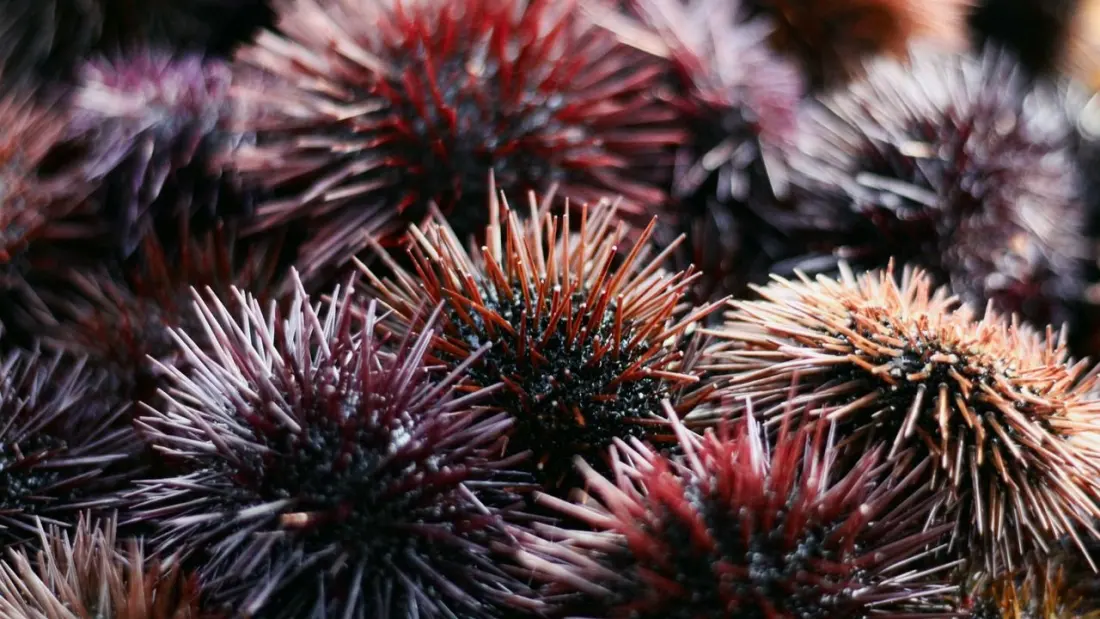
At Sea Ranch, a couple of hours north of San Francisco, a morning workshop has visitors wading into tide pools at dawn to pluck purple sea urchins straight off the rocks. Guide Nathan Maxwell Cann, a former North Bay restaurant bartender turned 'kelp guy', leads small groups through the basics: urchins look like curled hedgehogs out of water, hide their five golden tongues of roe under a spiky hemispherical shell, and come free with a clasp and a wiggle of a pair of tongs. The only real skill, participants learn, is staying upright on kelp-slicked rock.
The reason such an outing exists at all is an ecological crisis. Purple urchins have exploded along the California coast, mowing down kelp forests and leaving behind 'urchin barrens' — a pattern repeated in Alaska, Tasmania, New Zealand and South Africa. Historically the urchins were kept in check by sea otters and sea stars, but otters were hunted nearly to extinction for the fur trade in the early 1800s and still haven't returned to Sonoma's waters, while sea stars have been devastated by warming-worsened sea star wasting disease. With few predators left, the urchins graze unchecked.
That makes foragers stand-ins for the missing otters — though, as Cann admits, a group with bulging net bags barely dents the local population. Bigger efforts are underway elsewhere: Monterey's Giant Giant Kelp Restoration Project has built a submarine vacuum to suck urchins off the seafloor, Northern Californian divers simply crush them with hammers, and ranching operations fatten barrens-caught urchins on sustainably harvested kelp for restaurants. In Mendocino, a company called Marblis even compresses shells into 'urchinite', pitched as a marble countertop substitute.
The reward for the casual visitor is fresher than any sushi bar. Back on shore, kitchen shears cut a circle from the shell, the urchin is rinsed in seawater, and the roe is scooped out with a mussel shell. The result is rich and buttery — briny at first, then sweet — with the umami traced directly back to the kelp the animal eats. It even shows up on local menus: at the nearby Sea Ranch Lodge, chef Ryan Seal makes an urchin zabaglione as the base for a carbonara.
For travellers, the appeal is twofold. Half the fun is the meal; the other half is the excuse to really look at the tide pools, with their sea stars, anemones, camouflaged abalone and scuttling hermit crabs. Similar uni foraging workshops are popping up all over Northern California, and the activity suits ocean-curious beginners — no fishing licence gymnastics, no boat, just morning low tides and a cooler. It's a low-effort, high-reward introduction to a coastline with genuine ecological drama playing out beneath your feet.