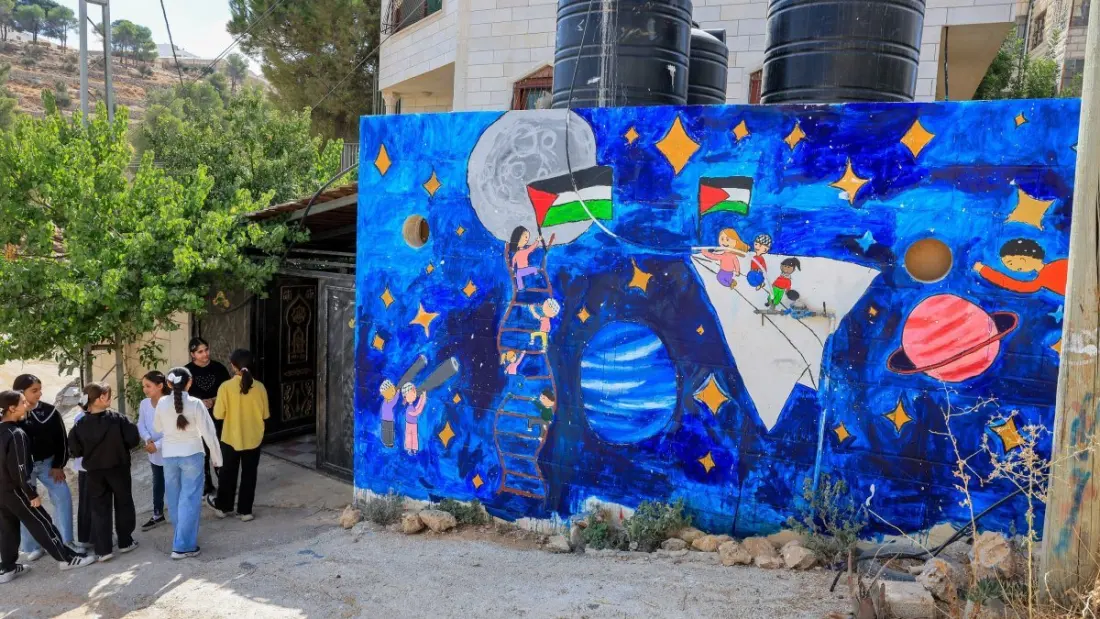
Wadi al-Samen is a quarter on the edge of Hebron that its residents say is cut off from the rest of the city by six military checkpoints. It is not an obvious place for an art studio. Yet in a converted storage room that once held nothing but carpets on the floor, Palestinian artist Sarah Abu Madi has built Rommana — Arabic for pomegranate — a centre where local children draw, paint and talk about the raids and settler violence that shape their daily lives.
Abu Madi founded the centre in 2020 with a simple method: after a military raid or an incident with settlers, the children are asked how it made them feel, what it made them think about, and what they wish could be different. The drawings that come out of those sessions are striking. One recent painting shows three children riding a winged horse — a dream of flying freely, unbothered by checkpoints. Ten-year-old Talia Sabah sketched birds escaping a cage and called it freedom. An eleven-year-old, Karam Sabah, described family farmland in the mountains that is now off-limits since a settlement was built there.
The need has grown. Rommana now works with around 600 children, and Abu Madi wants to reach all 3,000 living in the neighbourhood, where military raids and incursions from nearby settler outposts are frequent. The space itself has changed too: low plastic tables now sit beside murals the children painted themselves.
The art is also travelling further than the kids can. One exhibition of their work has already been held in Canada, and another is planned in Mexico. For Abu Madi, that is partly the point — art gives children permission to imagine a reality different from the one they live in.
Why does this matter to travellers? Hebron is one of the most contested cities in the West Bank, and most visitors who come see only the flashpoint zones of the old city on a day trip. Rommana offers a different lens: community-led, locally run and centred on the people who actually live behind the checkpoints. Anyone visiting the region — including the growing number who join West Bank tours beyond Jerusalem and Bethlehem — should seek out grassroots projects like this rather than treating the occupation as a backdrop. Buying the children's art, or simply spreading word of exhibitions abroad, does more for the neighbourhood than a snapshot at a checkpoint ever will.