
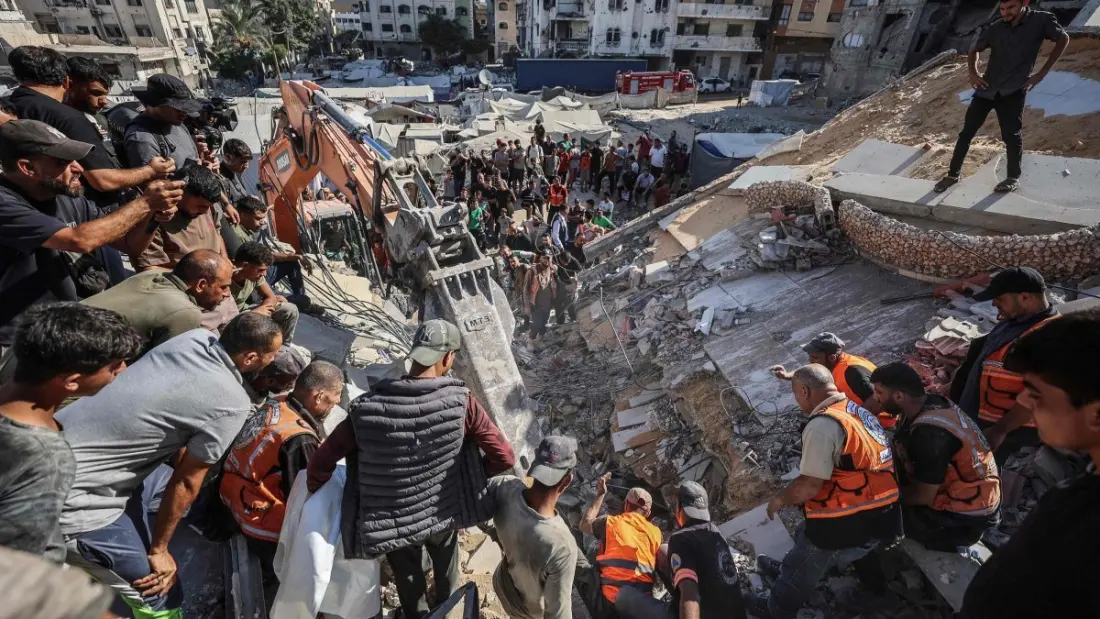
At least 12 people, five of them children, were killed when a seven-storey apartment block in Gaza City collapsed on residents while they slept overnight on Wednesday, according to Gaza's civil defense agency. Around 100 more people were believed to be trapped under the rubble, and 14 people were injured. The building had been damaged earlier in the war but was still housing families who had nowhere else to go.
Rescue teams, joined by staff from some UN agencies and Egypt's relief agency, worked by hand because heavy machinery is scarce in the territory. "We don't have the equipment and machinery that is needed. So there are actually people that are digging with their bare hands," said Alessandro Mrakic, head of the UN Development Programme's Gaza office. Raed al-Dahshan, who directs Gaza City's civil defense service, said rescuers could still hear voices beneath the debris and that around ten families had been living in the block.
The collapse points to a much wider hazard. Roughly 2,000 damaged buildings across Gaza are still inhabited, and officials estimate another 400 are at risk of falling, a danger that grows as winter storms arrive. The UN says the war, launched after Hamas's October 2023 incursion into Israel, has left about 61 million tons of wreckage that could take seven years to clear. Palestinian and UN officials blame Israeli restrictions for the shortage of excavation equipment; Israel says the curbs keep such gear away from Hamas.
A US-backed ceasefire in October 2025 halted large-scale fighting, but strikes have continued daily. Gaza health officials report more than 1,300 Palestinians killed since the truce took effect, while the Israeli military says four of its soldiers have died. Each side accuses the other of violating the deal, and talks on the wider US plan — an Israeli withdrawal and Hamas disarmament — have made little headway.
For travellers, the practical takeaway is simple and unchanged: Gaza and the surrounding area remain off-limits for leisure travel, and governments including the UK and US advise against all travel there. The story matters to a broader audience as a measure of how fragile the ceasefire is and how the region's humanitarian crisis continues to shape security assessments for anyone travelling elsewhere in Israel or the Eastern Mediterranean.