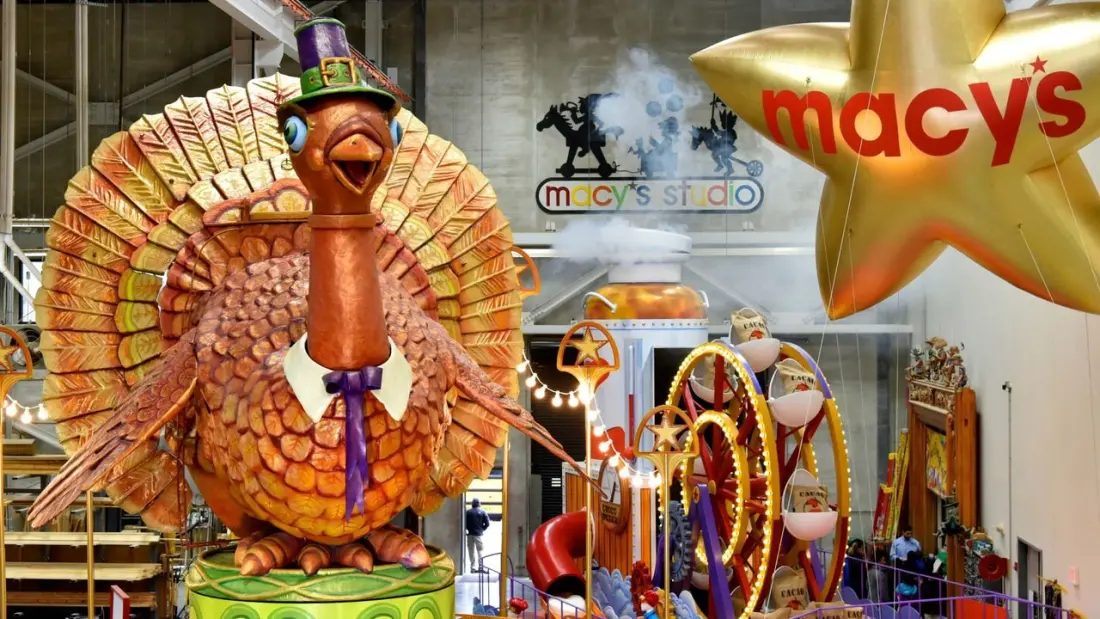
Tucked into an industrial park in Moonachie, New Jersey — about ten miles from Herald Square — sits a plain brick warehouse that most holiday traditions would envy. This 72,000-square-foot building is Macy's Parade Studio, home to 60 designers, welders, carpenters and seamstresses who spend all twelve months of the year getting ready for one November morning. Think of it as a soundstage crossed with the most ambitious arts-and-crafts classroom you've ever seen: Minions dangle from the rafters, Pikachu shares ceiling space with Goofy, and a Planters Peanut Ferris wheel spins on the floor below.
The timing of this behind-the-scenes look matters. The 2025 parade marks its 100th edition, and the studio has scaled up accordingly — nearly 100 inflatables instead of the usual 50 to 60, 1,000 new costumes instead of 500, and more than 11,000 volunteers. For context, the whole thing began in 1924 as a modest six-mile procession from Harlem to the flagship store, featuring live Central Park Zoo animals and Santa. The animals scared the kids, so three years later marionette pioneer Tony Sarg flipped his puppets upside down and attached them to strings — inventing the balloon tradition.
Everything starts small. In the 3-D print room, miniature models become engineering blueprints, and sculptors now even use augmented reality goggles while carving. Balloons are stitched from a closely guarded material — the formula and the heat-sealing machines (which run at 410 degrees Fahrenheit) are proprietary Macy's secrets — then painted, inflated indoors, and stress-tested at Balloonfest at MetLife Stadium before city agencies sign off. There are hard logistics too: every float must fold down to the size of a city bus to squeeze through the Lincoln Tunnel, with the convoy moving into Manhattan over two nights before Thanksgiving.
The human side is just as intricate. Costume director Kimberly Montgomery, in her 27th year, builds each kit around the float's theme and the weather — ear and hand warmers come standard, and costumes are cut loose for layering. Balloon handlers get colour-coded coveralls with a picture of their character; this year some balloons, like Buzz Lightyear and Sorcerer's Apprentice Mickey, need nearly 100 handlers each. There are heritage touches too, including a revived Mr. Inspector puppet from 1929 and 100 versions of Harold, a character dating to 1945.
Why care if you're not marching? Because the parade is free spectacle at its best: 3.5 million people line a 2.5-mile route from the Upper West Side to Herald Square, and the night-before Balloon Inflation on the Upper West Side streets is open to the public — arguably the best viewing experience of all, with the characters at ground level before they fly. If you're planning a Thanksgiving trip to New York around the centennial, book early and bundle up. The parade airs on NBC and Peacock from 8:30 a.m. to noon for everyone else.
Story via Condé Nast Traveler.