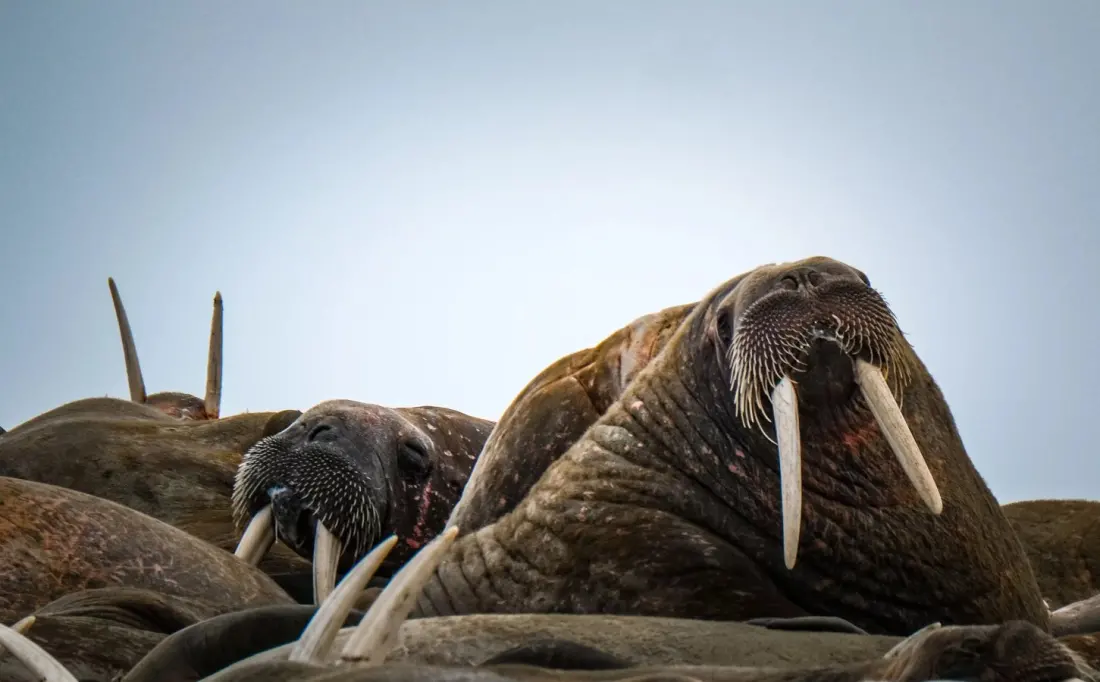
A roughly 192-square-kilometre stretch of Alaska's northwestern coast — including barrier islands and the neighbouring Kasegaluk Lagoon near Point Lay — is now permanently protected for Pacific walruses, following a conservation agreement announced in November.
The deal took about ten years to assemble. The Conservation Fund purchased the conservation easement from Cully Corporation, an Alaska Native corporation, and the Interior Alaska Land Trust will manage it going forward. Crucially, the agreement restricts surface development without shutting out the local community: residents of Point Lay can keep hunting and carrying out traditional subsistence activities in the area.
Why does a beach need protecting? Female Pacific walruses and their calves travel north through the Bering Strait each year to feed in the shallow Chukchi Sea, traditionally resting on floating sea ice between feeding dives. As that summer ice has become unreliable — a shift documented since 2007 — more walruses have taken to hauling out onto Alaska's Arctic beaches instead. A haul-out can hold thousands of animals packed shoulder to shoulder, and that's where things get fragile: a low-flying plane or a passing boat can trigger a stampede towards the water, and calves in particular are often trampled in the panic.
Point Lay's residents have effectively been volunteer wardens for years. The community has limited its own visits, asked pilots and boat crews to keep their distance, and hunters have adjusted some practices so the herds aren't startled. The walruses have now headed west towards Russia for the season, but when they return, the shoreline they rely on will be safeguarded for the long term.
So why should a traveller care? This is a rare, tangible conservation win — and a reminder of how wildlife tourism works best in the Arctic. If you ever find yourself on Alaska's northwest coast, the etiquette here is set by the community: give haul-outs a wide berth, keep aircraft and boats at a respectful distance, and treat the walruses as hosts rather than photo props. The story also doubles as a snapshot of climate change in action; the shift from ice to land resting spots is one of the clearest signs of a warming Arctic, visible in the behaviour of a single species.
This isn't a destination you can simply book a trip to — Point Lay is a small Iñupiaq village with no road access — but the protection deal matters to anyone who cares about the future of Arctic wildlife travel, whether you're watching walruses on a dedicated expedition cruise or following the region's conservation news from afar. It's also a good template: conservation led by an Indigenous community, with subsistence rights intact, rather than a fence-and-forget reserve.
For now, the best outcome is a quiet one: a beach where thousands of walruses can snooze between dives, heard but not disturbed by the people who live closest to them. Full details of the agreement were reported by Getaway South Africa.