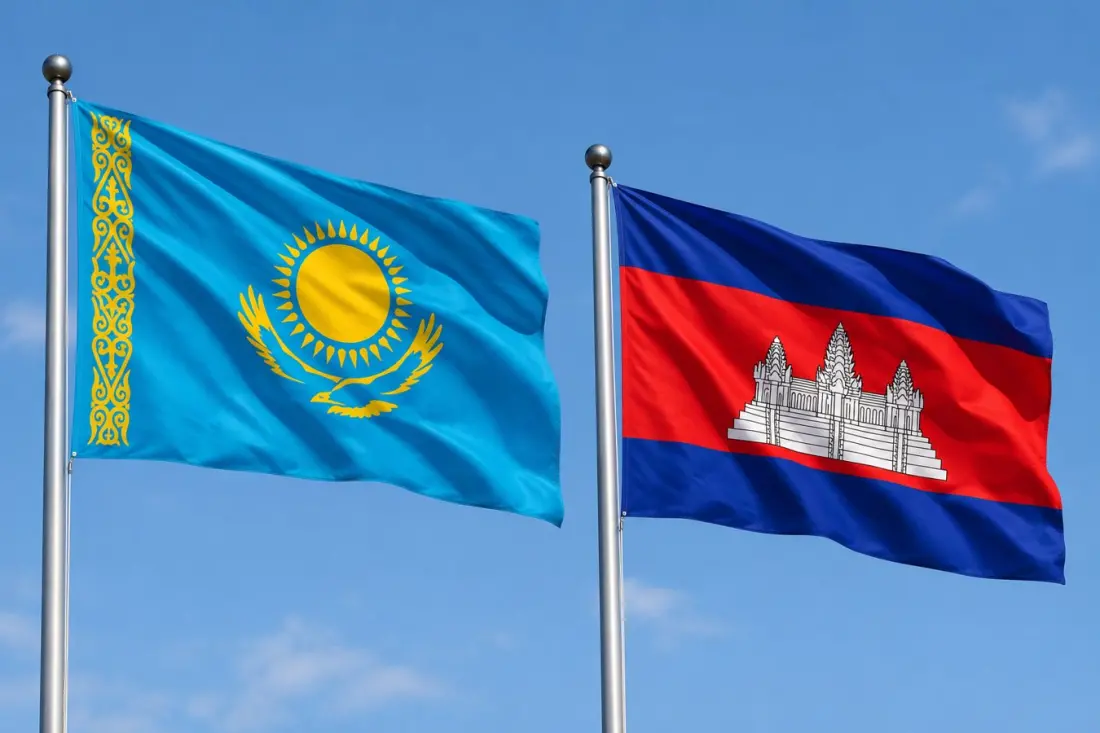
Kazakhstan and Cambodia are working to turn years of friendly diplomacy into something more concrete, with trade, agriculture, transport and tourism all on the table. The push comes ahead of a visit to Astana by Cambodian Prime Minister Hun Manet, and Kazakhstan's ambassador to Vietnam, Cambodia and Laos, Almas Tumysh, has laid out where the two countries see potential.
The numbers so far are modest. Bilateral trade hit $40.7 million in 2025, up from $33.8 million the year before, but it flows almost entirely one way — Cambodian textiles, knitwear and footwear heading to Kazakhstan. Kazakh exports to Cambodia in 2024 totalled just $47,000. Investment is even thinner: a mere $30,000 left Kazakhstan for Cambodia in the first half of this year, and no direct investment has come the other way at all.
That's exactly why both governments are talking about agriculture as the obvious starting point. Kazakhstan wants to sell wheat and fertilizers into a Cambodian market of 17.8 million people that imported around $34 billion of goods in 2025; Cambodia, which exported roughly $5 billion of agricultural products that year — rice, rubber, cassava, cashews and tropical fruit — could ship rice back. Officials are realistic, though: no volume targets have been set, and the first step is finding buyers, checking certification rules and pricing out the long logistics chain between Central Asia and Southeast Asia.
The travel-relevant part is connectivity. Kazakhstan wants to join ASEAN's Treaty of Amity and Cooperation, with Vietnam, Laos and Cambodia backing its bid, and the two sides are considering multimodal route studies that could involve Cambodia's main seaport, Sihanoukville. There's even airline precedent: SCAT Airlines ran charter flights from Astana and Almaty to Sihanoukville starting in October 2024 before suspending them — experience both countries say could inform future route decisions. With Cambodia welcoming about 5.57 million international visitors in 2025, tourism cooperation between the two governments is flagged as a growth area too.
A visa deal already exists for diplomatic and official passport holders (agreed in May 2025), but ordinary travellers still follow standard rules. Digital government and e-commerce cooperation rounds out the agenda, with Kazakhstan offering its much-promoted e-government know-how to Cambodia's fast-developing digital services sector.
For now, this is a story about early-stage diplomacy rather than bookable flights or tour packages. But for travellers watching Central Asia open up, it signals intent: if Kazakhstan secures a foothold in Southeast Asia and the charter route experiment gets revisited, Astana-to-Angkor via Sihanoukville becomes easier to imagine. Tour operators and airlines on both ends are clearly being encouraged to test demand. Until then, anyone keen on the combination will still need to route through hubs like Bangkok, Hanoi or Seoul — and keep an eye on whether these talks turn into signed contracts and, eventually, restored air links.