While Prince Edward Island celebrated a record 1.87 million visitors in 2025, a small island chain a five-hour ferry ride away quietly had its own record season — with barely 70,000 guests. The Magdalen Islands (îles de la Madeleine, or "the Maggies") in the Gulf of St. Lawrence are one of eastern Canada's best-kept secrets, and the numbers make the case: roughly 96% fewer tourists than PEI, with scenery that rivals anywhere on the Atlantic.
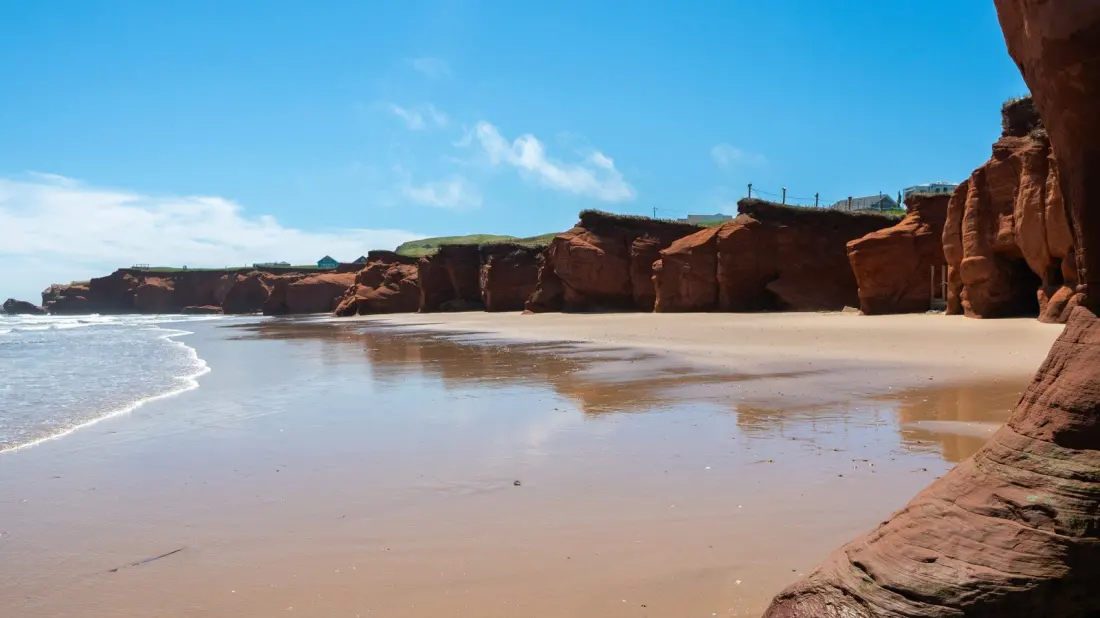
The headline feature is the beaches: 190 miles of pale white quartz sand backed by rust-red sandstone cliffs. The two go hand in hand — the eroding cliffs are quartz coated in iron oxide, and when the rock meets salt water the iron washes out, leaving the powdery white sand behind. The effect is a striking red-and-white shoreline that few Canadians outside Quebec have seen.
Counterintuitively for islands sitting well north of the U.S. border, the swimming here beats many beaches to the south. Sheltered lagoons and bays can hit nearly 70°F in late August and September, warmed by Gulf Stream currents and shallow shoals — some claim it's the warmest water north of the Carolinas.
The archipelago numbers about a dozen islands, six of which are linked by roads over sand dunes. Route 199 runs the full 55-mile length, so you can drive, bike or hike almost the entire chain. Only Entry Island needs a boat. Locals — about 12,900 of them, known as Madelinots — are mostly French-speaking Acadians, but English is common in tourism settings.
Getting there takes planning. The main route is the ferry from Prince Edward Island; you can also fly into Îles de la Madeleine Airport (YGR) on Havre aux Maisons, about two hours from Québec City. The tourism board strongly advises booking transport and accommodation well ahead — and remember the islands run on Atlantic time, an hour ahead of mainland Quebec.
Food is a major draw in its own right. Fishing drives the local economy, so lobster, snow crab, scallops and clams end up in everything, including pot-en-pot, a traditional seafood pie. More adventurous eaters can try seal — one of the few places in Canada where it's eaten — or croxignoles, a braided pastry fried in seal oil. Wash it down with la bagosse, the local beer, sometimes brewed with wild cranberries (pommes de pré) that grow in the dunes. Look for the label "Le bon goût frais des Îles de la Madeleine" to find genuinely local produce.
For travellers who like their beaches empty, their seafood hyper-local and their road trips contained to one scenic 55-mile route, the Magdalen Islands are an easy sell — provided you book early and don't mind brushing up a few phrases of French.