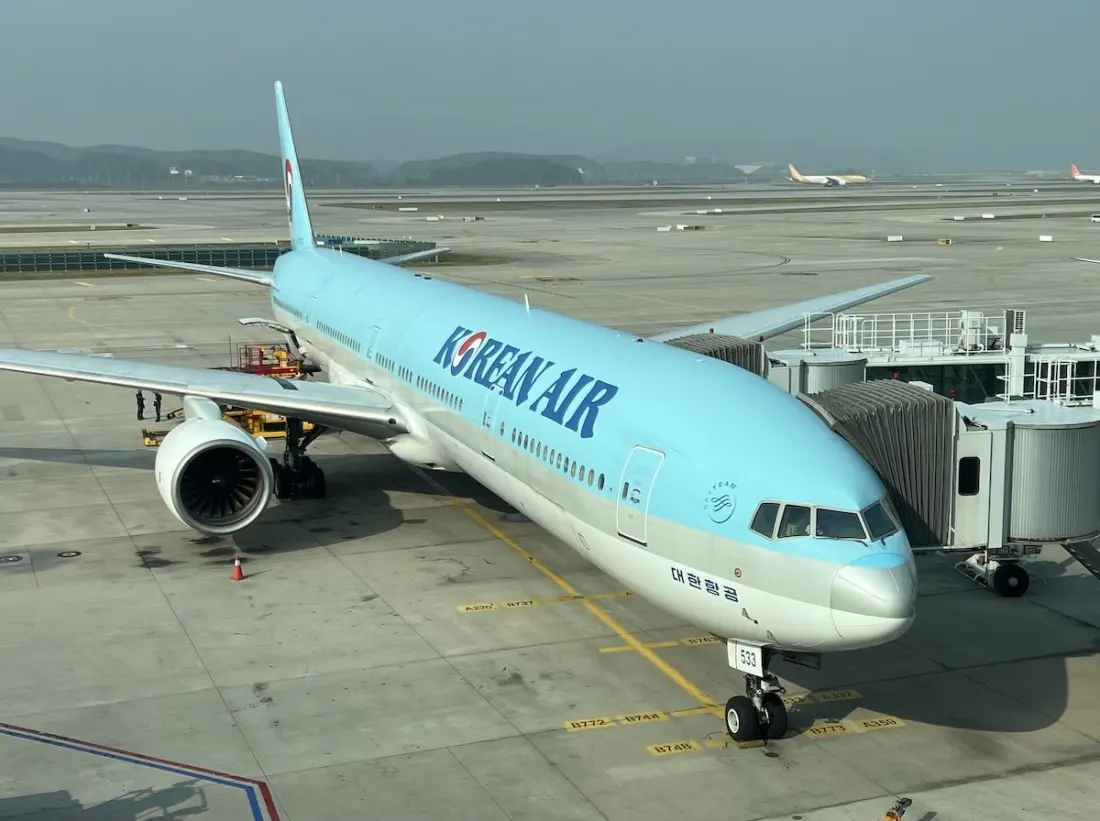
Korean Air is heading back to Newark. From 22 May 2027, the carrier plans daily nonstop flights between Seoul Incheon and Newark Liberty, a route it last flew until September 2001, when service was dropped after 9/11 and never revived. What was once an unserved market will soon have three airlines on it.
The new flight, KE97, leaves Incheon at 10pm and lands in Newark at 11pm the same day; the return, KE98, departs at 1am and arrives in Seoul at 5:15am the following day. The 6,896-mile sector is blocked at around 14 hours westbound and just over 15 hours eastbound. Korean Air will fly it with a Boeing 777-300ER configured with eight first class seats, 42 in business and 227 in economy — a proper flag-carrier product on a route currently dominated by smaller widebodies.
The competition angle is striking. Air Premia, a South Korean hybrid low-cost carrier, launched the route with a Boeing 787 in May 2023. United followed with its own 787 service in September 2026. From zero daily flights a few years ago, Incheon-Newark will now see three daily departures across three airlines — and Korean Air's schedule sits at similar times to Air Premia's.
Why would Korean Air add Newark when it already flies to JFK twice daily? The answer lies in the completed merger with Asiana. With the two carriers now operating under one brand, the combined airline is trimming duplicate frequencies on saturated routes like Los Angeles, New York and San Francisco, freeing capacity for new points. Newark also makes sense beyond Manhattan: it taps New Jersey and Pennsylvania, and there's strong demand from the Korean side of the market, including the large student population in the region. The airline's Delta joint venture means fares and schedules can be coordinated across the alliance, so Newark slots neatly into a broader transpacific network.
For travellers, this is genuinely good news. Newark is often the more practical New York-area airport for anyone based in northern New Jersey, and competitive pressure from three airlines on one long-haul route usually means better fares. Korean Air's 777-300ER also gives the route first class — an unusual perk for a secondary US gateway — while its Incheon hub remains one of the easiest places in Asia to connect through. Anyone flying from the US East Coast to Seoul, or onward to Southeast Asia via Korea, now has an extra option with a well-regarded carrier.
One caveat: schedules this far out can shift, so anyone planning a trip for summer 2027 should keep an eye on the booking window before locking in plans. But as it stands, this is the most interesting US-Korea route development in years.
One Mile at a Time