Limerick doesn't get the tourist crowds of Dublin or Galway, and that's exactly its appeal. Ireland's third-largest city sits on the River Shannon, roughly halfway between Galway and Cork, and packs in medieval streets, a walkable riverfront and a serious craft beer scene without the queues.
The history here runs deep — the county's human story stretches back some 9,000 years, Vikings founded the settlement around A.D. 922, and the Normans took over in 1195, leaving behind much of the medieval architecture you see today. (Yes, the city probably lent its name to the five-line poem, courtesy of an old Irish military song.)
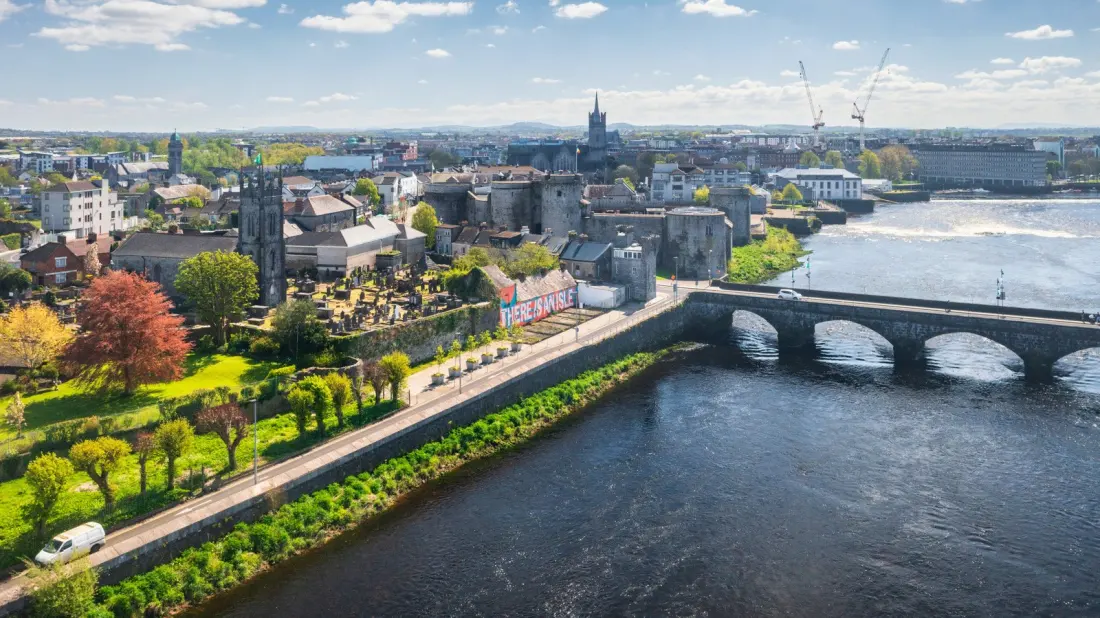
The medieval quarter sits on King's Island in the middle of the Shannon. Its headline attraction is King John's Castle, a 13th-century fortress named after the same monarch who plays villain in the Robin Hood legends. It's open to visitors, with exhibits and tours — but the real payoff is the view from the walls over the river, St. Munchin's Church and the houses on the far bank. A short walk away stands St. Mary's Cathedral, a 12th-century building and the oldest structure in the city still serving its original purpose.
Cross to the west bank for Limerick Museum, housed in an old friary, and the Treaty Stone on Clancy's Strand, where the 1691 Treaty of Limerick was signed, handing the city to William of Orange. The boardwalk here is a good spot to watch the Curragower Falls with the castle across the water.
When sightseeing is done, Limerick drinks well. Treaty City Brewery, founded in 2014, is the centre of the local craft scene and sits in the medieval district around the corner from the castle — ideal for a pint or a flight after a castle tour. J.J. Bowles, said to be the city's oldest pub, covers the Guinness-and-whiskey side of things. Bonus for road-trippers: Irish coffee was invented in 1943 in Foynes, about 45 minutes west.
Getting there is straightforward. Shannon Airport is a 30-minute drive away, with flights from hubs like Boston, Chicago, Edinburgh and London; the route passes Bunratty Castle & Folk Park. Alternatively, fly into Dublin and drive about three hours southwest, or take a bus from Galway or Cork.
Limerick works as a destination in its own right, but it also makes a great base. The Wild Atlantic Way is within easy reach: head southwest for the Dingle Peninsula or Killarney National Park, or north to Galway, with ferries to the Aran Islands nearby. Rugby fans can catch a match at Thomond Park, home of Munster. If you want an Irish city break with genuine medieval bones, river views and a proper pint at the end of the day — minus the crowds — this is the one.