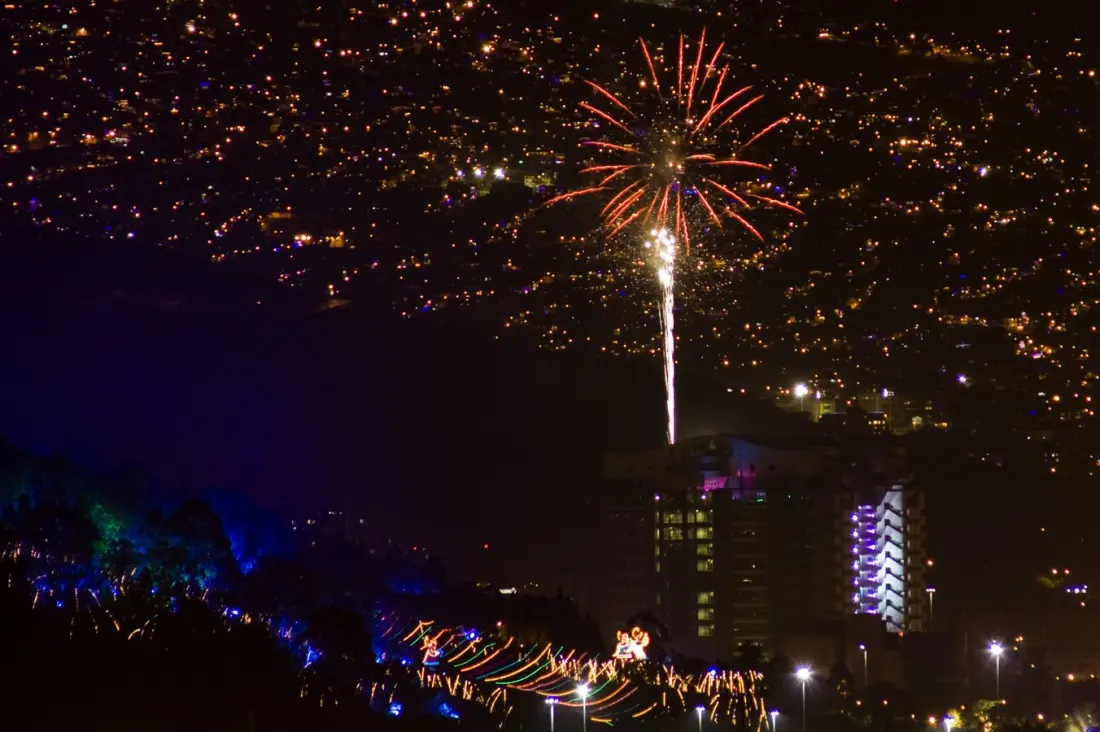
At midnight on November 30, Medellin erupts. Fireworks fill the sky over the city and the wider Aburrá Valley as residents kick off the Christmas season in a tradition known as the Alborada. For families across Antioquia it's the unofficial start of December — a month of light displays, novenas (Christmas prayer gatherings) and long nights of food and music. But the celebration carries baggage most visitors never hear about.
The modern Alborada traces back to a startling origin: November 30, 2003, when members of the Cacique Nutibara Bloc, a paramilitary unit of the AUC, marked their demobilization with a huge coordinated fireworks display — an event historians see as much a show of territorial power under leader Diego Fernando Murillo Bejarano, alias Don Berna, as a celebration. Over the following two decades, the practice shed that context and spread neighborhood by neighborhood until it became one of the city's defining holiday rituals.
Today the debate is less about history than about safety. Medellin's health authorities recorded 82 fireworks injuries in the 2025–2026 Christmas and New Year season, including 29 minors — and nearly 44% of victims were bystanders, not people handling fireworks. Pets and wildlife suffer too: dogs and cats panic, flee and get lost, while birds abandon nests and collide with buildings. Burning debris adds fire risk to rooftops and green spaces.
For the 2026 season, the Mayor's Office is pushing a "Medellin Without Fireworks" campaign, deploying over 270 outreach workers across city districts, running awareness events from November 22 to 30, and staging alternatives — including a pet adoption fair outside the Museum of Modern Art where 80 dogs and cats found new homes. Door-to-door outreach in neighbourhoods like Buenos Aires, Laureles and Robledo on November 30 asks residents to skip the pyrotechnics, and authorities also warn against floating paper lanterns, a separate fire hazard. A city survey found nine in ten respondents actually prefer fireworks-free celebrations.
Why should a traveller care? If you're in Medellin in late November, you'll experience one of the most intense nights of the local calendar — streets alive, bars and restaurants leaning into the occasion, families gathering on balconies. Knowing the risks and the history gives you a fuller picture: keep your distance from anyone lighting fireworks, protect your ears, and consider the city's official cultural events instead. The Alborada is a fascinating window into how a city reclaims its own traditions — and December in Medellin, with its famous light shows, remains one of the best times to visit Colombia's second city.