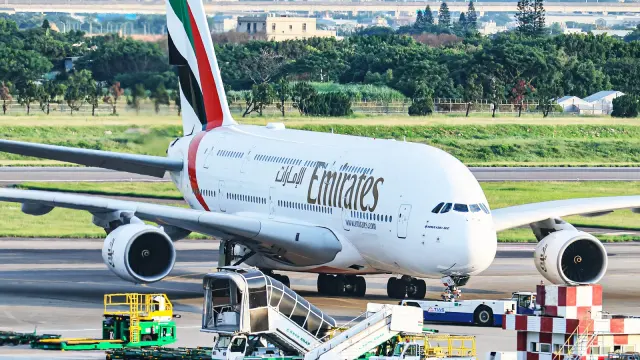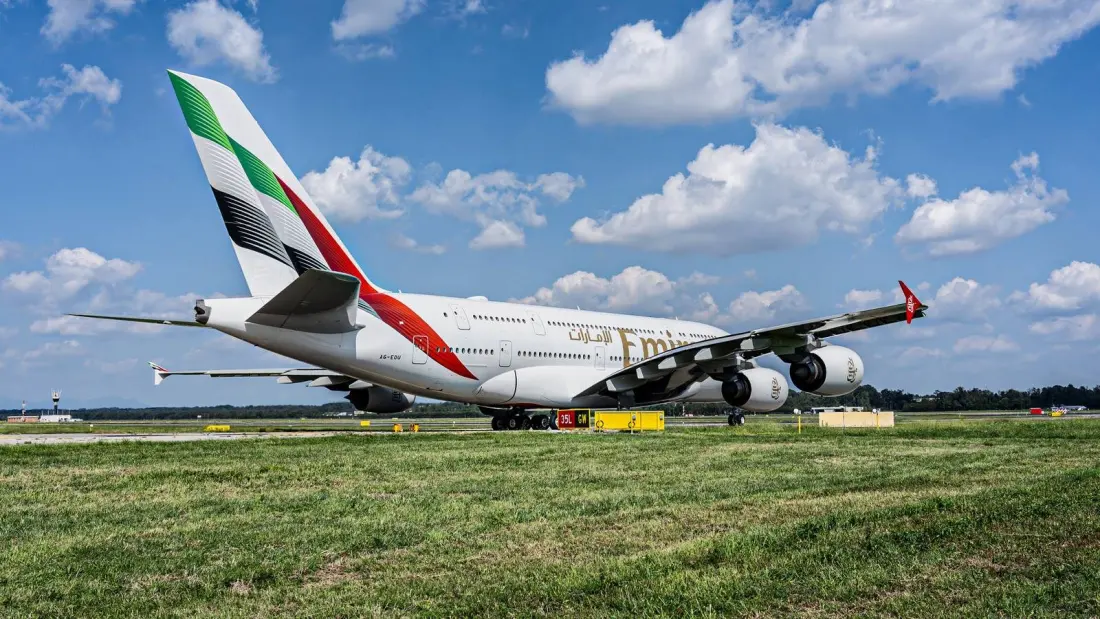
The numbers sound absurd. An Airbus A380 burns roughly 4,600 gallons (about 17,400 litres) of fuel every hour — nearly double the ~2,700 gallons an Airbus A350-1000 drinks over the same period. Emirates President Tim Clark has framed it another way: on a Dubai to Los Angeles flight carrying 515 passengers, the superjumbo burns around 13 tonnes of fuel per hour, with the whole trip costing roughly 200 tonnes. Most airlines look at those figures and walk away. Emirates has built a record-breaking business on them.
The trick is simple maths. Divide that enormous hourly bill across 500-plus seats and the per-passenger fuel cost can actually undercut running two Boeing 787s on the same route — provided the cabins stay full. That is where Dubai comes in. As a connecting hub, the airport funnels transfer traffic from multiple continents onto each long-haul flight, keeping occupancy consistently high in every cabin, from economy to first. Airlines relying mainly on point-to-point local demand simply cannot fill a double-decker every day.
Scarce airport slots amplify the advantage. At congested hubs like London Heathrow and Hong Kong, an airline only gets so many takeoff and landing rights. Putting a 517-seat A380 into one slot beats parking a 787 there and selling half as many seats at peak demand. Emirates is one of very few carriers with both the slot pressure at destinations and the hub scale at home to exploit this — Air France, by contrast, retired its entire A380 fleet in 2020 because it couldn't keep the seats filled.
The financial results back the theory. Before the pandemic, Clark told Simple Flying that around 85% of Emirates' profits came from the A380. More recently, in the airline's record 2025–26 results, he called the type the most profitable asset in the fleet. The Emirates Group posted a record profit of AED 24.4 billion (about $6.6 billion) that year, with the airline itself at AED 22.8 billion before tax.
Emirates plans to keep flying its A380s until around 2041, and Clark has floated a re-engined A380neo that could cut fuel burn to roughly nine tonnes per hour — with an order of at least 100 aircraft on the table. Airbus, though, reportedly wants about 250 orders to restart the line, so the standoff continues and the existing fleet will have to do the heavy lifting.
For travellers, the practical upshot is that the world's most spacious airliner keeps flying the busiest long-haul routes — including Heathrow routes with A380-only service — for years to come. For the rest of the industry, the A380 remains a specialist tool that only works under very specific conditions. Emirates happens to have all of them.