Most seabirds fish. The magnificent frigatebird would rather take your fish off you. With a wingspan of around 2.2 metres, a forked tail and wings built for long, lazy gliding on tropical air currents, Fregata magnificens spends much of its life airborne — and it has earned its pirate reputation honestly.
Its signature move is kleptoparasitism: chasing other seabirds mid-flight until they panic and drop or regurgitate their catch, which the frigatebird then snatches in the air. It does hunt for itself too, skimming fish and squid from the ocean surface, but it never dives. Oddly for a seabird, its feathers aren't properly waterproof, so landing on the sea isn't an option. It lives by staying up.
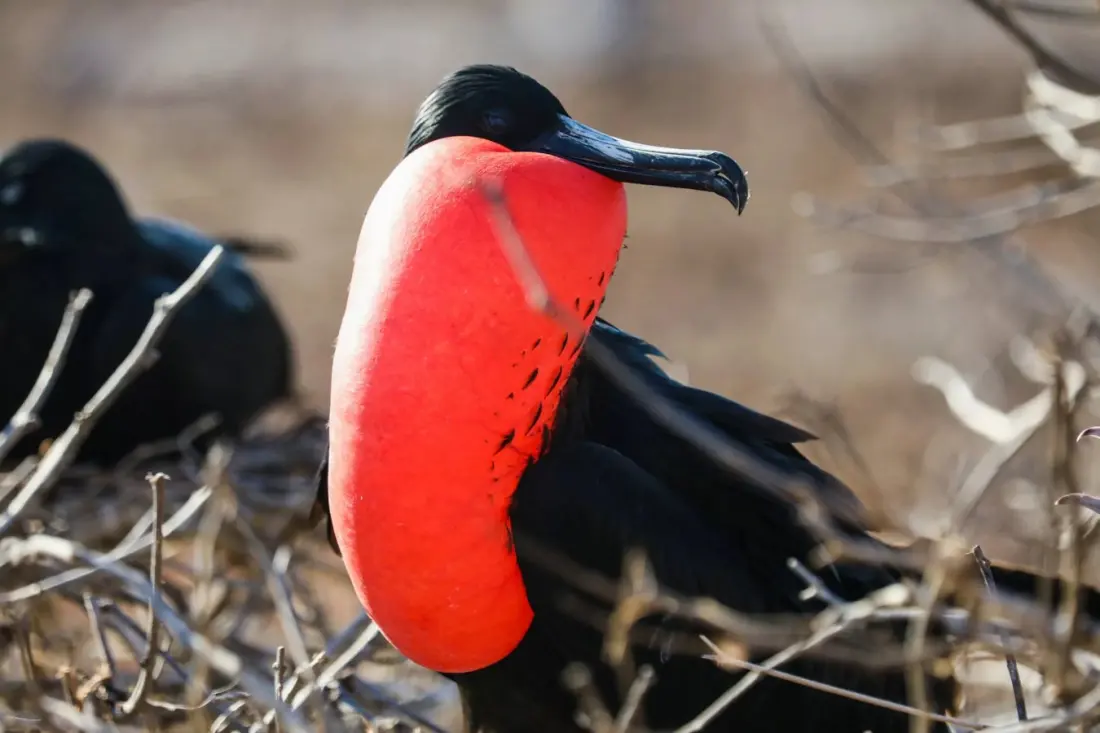
Then there's the romance. During breeding season, males gather in groups and inflate a bright red pouch on their throats — the gular sac — until it looks like a balloon. Bills raised, beaks rattling, they call up to females flying overhead. Subtle it isn't. The pouch deflates to near invisibility outside breeding season, and you can tell the sexes apart easily: females have a dark head and white breast, while juveniles show white heads and underparts.
What's surprising is how much these aerial opportunists invest in family. Both parents incubate the single egg for about 56 days, the chick stays in the nest for five to six months before fledging, and the female may keep feeding it for up to a year. For a bird that spends most of its life on the wing, that's a serious commitment.
Where can you actually see one? The species ranges across tropical and subtropical waters of the Americas — the Caribbean, the Gulf of Mexico, Central America and the Pacific coast of South America — and it's a highlight of any trip to the Galápagos. You don't need binoculars to spot the silhouette: long narrow wings, scissor tail, effortless glide above the coast. A useful tip: if a flock of seabirds suddenly turns noisy and starts chasing each other, look up. A frigatebird is probably working the crowd.
One note for birders in South Africa, where the source publication is based: the magnificent frigatebird belongs to the Americas. The great frigatebird, a separate species, is the one you'd find around the Indian and Pacific oceans — so log your sightings carefully.
Why should a holidaymaker care? Because frigatebird colonies are one of those wildlife spectacles that need no boat timetable or luck with big game — just a coastal walk during breeding season. In places like the Galápagos or the Caribbean, males with inflated red pouches are practically a guaranteed photo, and watching a piracy chase unfold overhead beats any documentary. If your next trip takes you anywhere along tropical American coastlines, keep an eye on the sky.