
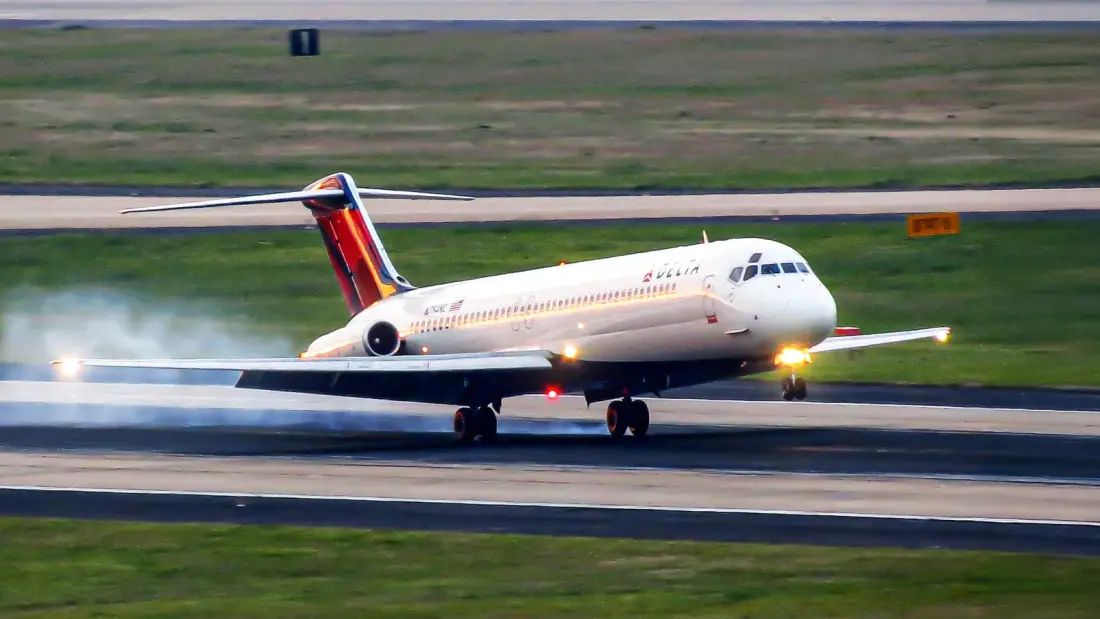
Delta Air Lines' last scheduled DC-9 passenger flight left Minneapolis-St. Paul for Atlanta on January 6, 2014 — but that date matters less than the reason the type lasted so long in the first place. The Twin Cities wasn't just where an old jet happened to be based. It was the one US hub whose entire economics still made sense for a 1960s narrowbody.
The story starts with Northwest Airlines, which built the world's largest DC-9 fleet — 178 aircraft at its peak — around MSP. The hub's geography did much of the work: a spread of smaller Midwestern cities, tough winters, and steady demand for frequent, short hops. The DC-9, with its compact size and rear-mounted engines, could serve those thin routes with jet speed without flooding them with seats. Crucially, Northwest also had the crews, maintenance base, and spare parts to keep decades-old airframes productive. Age alone doesn't ground an aircraft — losing the supporting system does.
When Delta absorbed Northwest in the 2008 merger, it inherited 97 DC-9s. Many were already paid for, and in airline accounting that counts for a lot: an owned airframe generating revenue can beat a shiny new lease if fuel and maintenance stay manageable. So the DC-9s kept flying while Delta integrated two airlines. But the math eroded. The Pratt & Whitney JT8D engines burned far more fuel than modern equivalents, parts grew scarce, and Boeing 717s — a direct descendant of the DC-9 with newer engines and cabins — began arriving from former AirTran stock in 2013, covering much of the same work more efficiently.
Delta staged a proper send-off. Flight DL1965 flew Detroit to Minneapolis (the number marking the DC-9's 1965 launch year, which Delta itself operated as the type's first scheduled service), then DL2014 departed MSP for Atlanta. The aircraft, N773NC, had its own fitting résumé: delivered to North Central Airlines in 1978, then Republic, then Northwest, then Delta. A footnote for avgeeks — two DC-9s lingered on standby, so the genuinely final flight happened on January 22, 2014.
The wider tale closed only in May 2026, when Delta pulled its Boeing 717s from MSP in favour of the Airbus A220. That ended over six decades of T-tail, rear-engine narrowbody flying at the hub — a full arc from Northwest's DC-9 empire to modern jets doing the same job for less fuel.
Why should a traveller care? MSP is one of the great American hubs precisely because of this lineage — airlines there perfected the frequency-driven, small-aircraft network model that still shapes schedules today. And if you love aviation history, the Twin Cities remains one of the more rewarding airports to explore, with strong Delta connections to everywhere the DC-9 once flew.