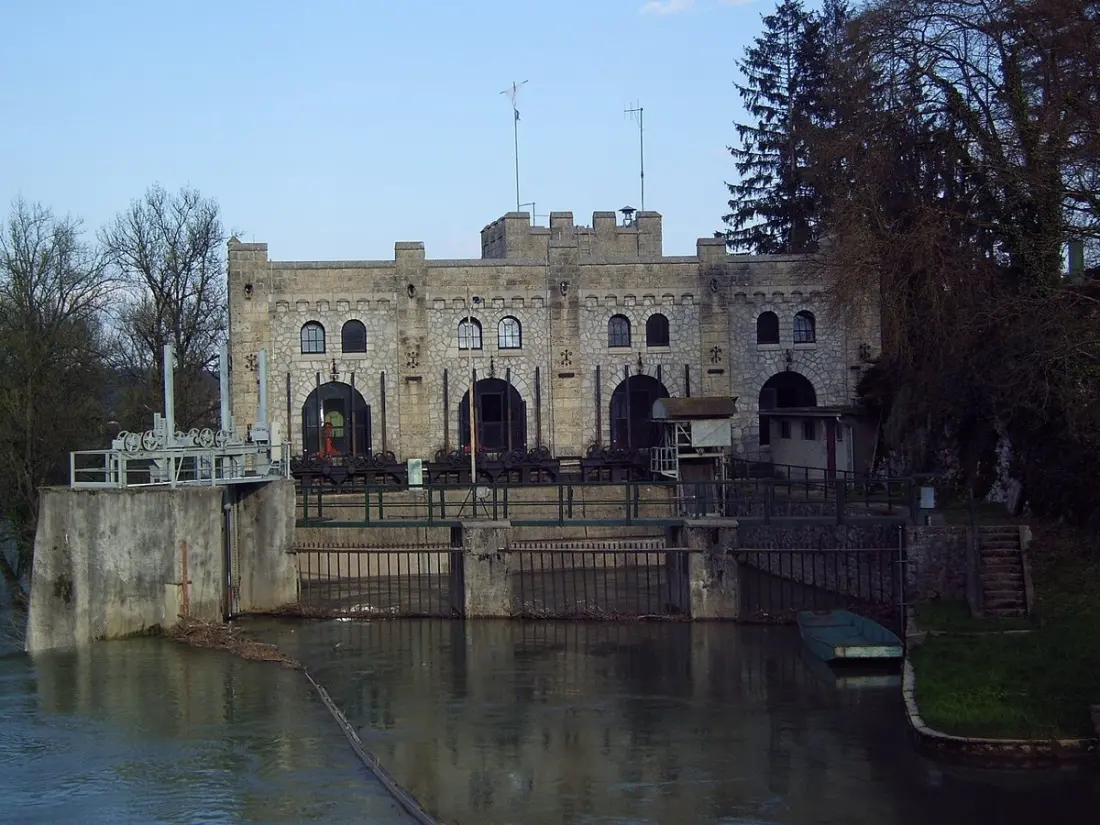
On a natural waterfall of the River Kupa in Ozalj stands a building that most people would mistake for a neoclassical palace. Stone battlements, elegant arcades, tall spruces framing the view — and inside, two Francis turbines that have been quietly generating electricity since 1908. This is Munjara, the oldest hydroelectric power plant in continental Croatia, and it's still very much in business after 118 years, running more than 5,000 hours a year.
The story behind it is better than the postcard. Nikola Tesla himself lobbied as early as 1892 for a hydroelectric plant on the Kupa or the nearby Korana. His vision came true in 1908, when the town of Karlovac finally got public electric lighting, powered by Munjara. For a while, that electricity was free. Construction took a mere 15 months, which would be quick even now. Civil engineer Valerijan Rieszner designed the technical side, while the handsome historicist facade came from Hermann Bollé — the Austrian architect behind Zagreb's Mirogoj cemetery and the Museum of Arts and Crafts.
Ozalj itself is worth the trip. The small town sits on a cliff above the Kupa, about 17 kilometres from Karlovac, and from the power plant you get a fine view of its Old Town stone complex. For context on Croatia's early electrification: Šibenik was first in 1895, Zagreb followed in autumn 1907, and Munjara then helped drive the industrial growth of Ozalj, Karlovac and Duga Resa through the decades after. By 1948, demand had grown enough that a second plant was built on the left bank of the river — though neither matches the original for sheer drama.
Today Munjara is a protected cultural asset under Croatia's Ministry of Culture, and it can be visited on a guided tour led by the plant's own expert staff. You'll need to register in advance, but standing inside a working piece of industrial history that resembles a fortress is a rare thing anywhere in Europe.
Why bother adding it to a Croatian itinerary? Because most travellers stick to the coast and miss this side of the country entirely. Ozalj makes an easy detour between Zagreb and the Karlovac region — pair it with the river views, the Old Town, and perhaps a stop in Karlovac itself. It's a genuinely unusual half-day: part engineering pilgrimage, part castle visit, all in a sleepy riverside town most guidebooks skim past. If you're the kind of traveller who likes your landmarks with moving parts, this one still hums.