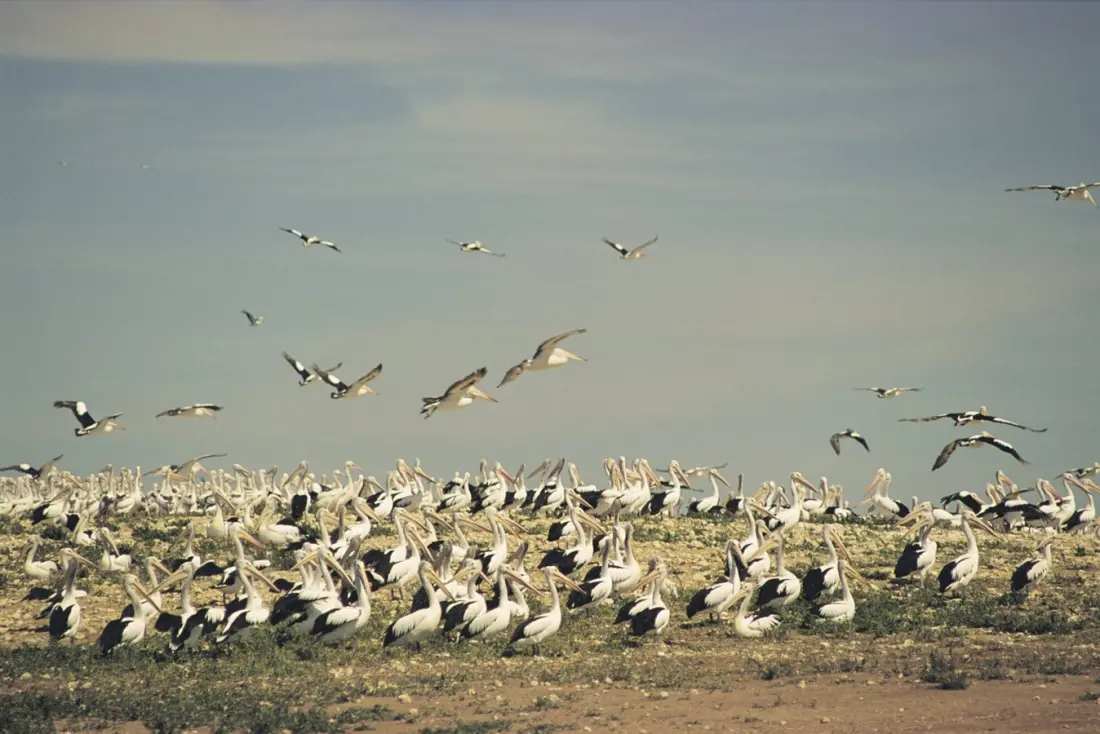
Half a century after it hit cinemas, Storm Boy remains one of the most-loved films in Australian cinema — and much of that staying power comes from where it was shot. The 1976 classic, directed by Henry Safran and adapted from Colin Thiele's 1964 novel, unfolds along South Australia's Coorong, the sweeping coastal wetland where the Murray River meets the Southern Ocean.
The film made a quiet boy-and-his-pelican story into a phenomenon: it grossed over A$2 million at the Australian box office, took out Best Film at the 1977 AFI Awards and sold to more than 100 countries. Producer Matt Carroll and Thiele both adored the Coorong, and cinematographer Geoff Burton turned its dunes, lagoons and birdlife into the film's visual signature — barefoot Mike (Greg Rowe) in his oversized sweaters, ranging across pristine wetlands with pelicans Mr Percival, Mr Proud and Mr Ponder.
Plot-wise, Mike lives in an isolated dune hut with his father Tom (Peter Cummins), a fisherman selling cockles and mullet in nearby Goolwa. His only companion is Fingerbone Bill, played with real emotional depth by the great Yolŋu actor David Gulpilil. Fingerbone rescues the orphaned pelican chicks, mentors Mike in caring for them, and pushes him towards school and reading. Rowe later recalled that he and Gulpilil called each other by Yolŋu names for 'little brother' and 'big brother' throughout the shoot. The article argues the film is really about that friendship — and about Mike's rite of passage through loss — with Fingerbone quietly asserting Aboriginal connection to country: 'Whitefella law!' he snaps when Tom cites the ranger.
For travellers, the useful part is that this landscape is real, protected and visitable. The Coorong National Park stretches along the coast south-east of Goolwa, offering lagoons, birdlife and dune walks barely touched since the film. The 2019 remake with Geoffrey Rush returned to the same locations, this time formally acknowledging the Ngarrindjeri and Kaurna peoples — a good cue for visitors to engage with the area's living Indigenous culture too. The restored 1976 version, digitised by the National Film and Sound Archive in 2015, is easy to find if you want to watch before you go.
There's also a broader film-history hook: Storm Boy was the third release from the South Australian Film Corporation, founded in 1972, whose early slate helped kickstart the Australian New Wave. Picnic at Hanging Rock and Sunday Too Far Away preceded it, and other states soon copied the model — meaning a road trip through South Australia doubles as a tour of 1970s cinema landmarks, from the Flinders Ranges to the coast.
Storm Boy endures not just because of a boy and a bird, but because of a place that looks like nowhere else. Fifty years on, the Coorong is still waiting for you to walk it.