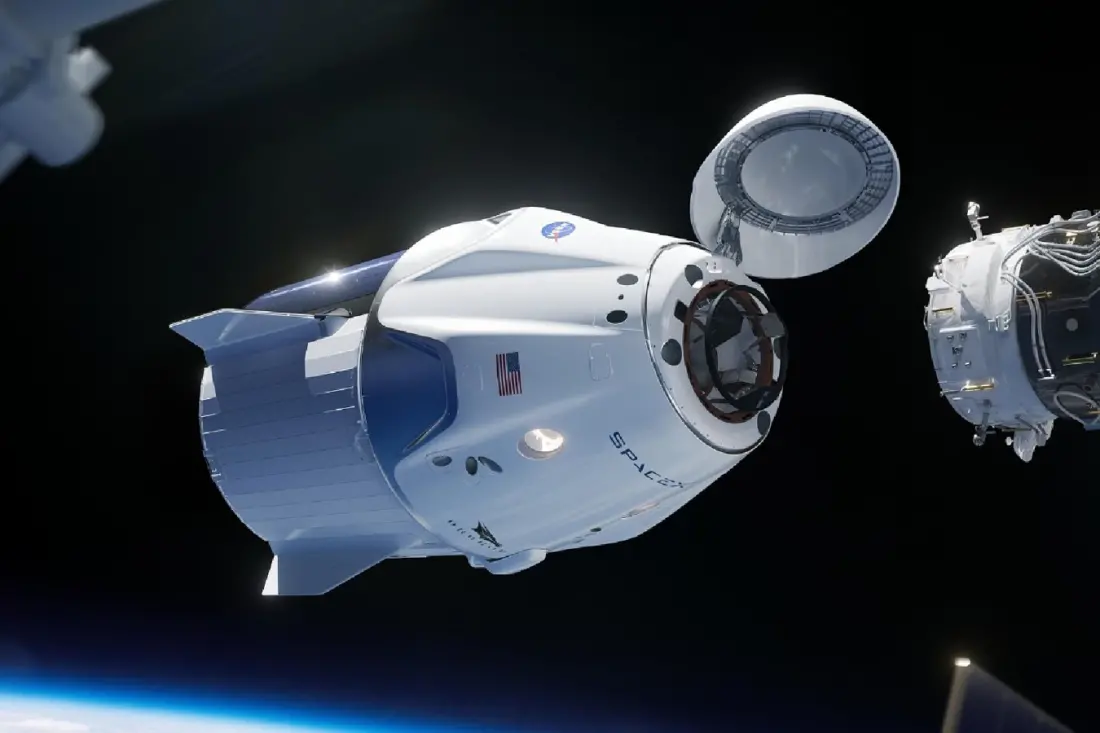
Two NASA spacecraft currently loitering near Earth are about to slingshot themselves to Mars, and the maneuver could briefly put on a show for anyone with a decent telescope.
The twin Escapade probes will each perform a powered flyby of Earth in early November: the first on Saturday, Nov. 7 at around 5 a.m. EST, and the second on Monday, Nov. 9 at roughly 6 a.m. EST. Rather than a simple gravity assist, each craft will fire its engines for about nine minutes during closest approach — a first for a Mars-bound mission — picking up more than 1,000 mph of extra speed. Post-burn, they'll be zipping along at roughly 6.7 miles per second, finally on a true trajectory for the Red Planet.
They won't exactly be skimming rooftops, but it's still a close call by space standards: the spacecraft will pass somewhere between 600 and 1,100 miles above the surface. NASA says observers might see them as faint points of light drifting slowly against the stars, though a telescope is almost certainly required. Your best odds depend heavily on location. Parts of southern Australia are the prime viewing zone, ideally during the engine burns, while skywatchers in the western United States may get a look in the hours before each closest approach. The catch for US-based viewers: the probes will be below the horizon at the exact moment of flyby. Anyone serious about tracking them should use the Jet Propulsion Laboratory's Horizons System for real-time sky positions.
There's a backstory here worth knowing. Escapade — short for Escape and Plasma Acceleration and Dynamics Explorers — launched in November 2025 on Blue Origin's New Glenn rocket from Cape Canaveral. Instead of heading straight for Mars, the two craft travelled toward the Earth-Sun Lagrange Point 2, about a million miles away, and parked in a distant orbit waiting for the right planetary alignment. That flexible route matters: it means NASA can send Mars missions outside the traditional launch windows that only open roughly every 26 months.
Once on target, the probes are due to arrive at Mars on Sept. 7 and Sept. 9, 2027, then settle into coordinated formation orbit — another first. Their job is to study how solar wind strips away the Martian atmosphere, a process scientists believe turned a once possibly habitable planet into the cold, thin-aired world we see today.
So who should care? If you're in southern Australia or the American West and you own a telescope, this is a genuinely rare sight: human-built craft returning from deep space, firing engines in full view. It's not an easy catch, but for astronomy-minded travellers it's the kind of one-off celestial event worth planning a clear November morning around.