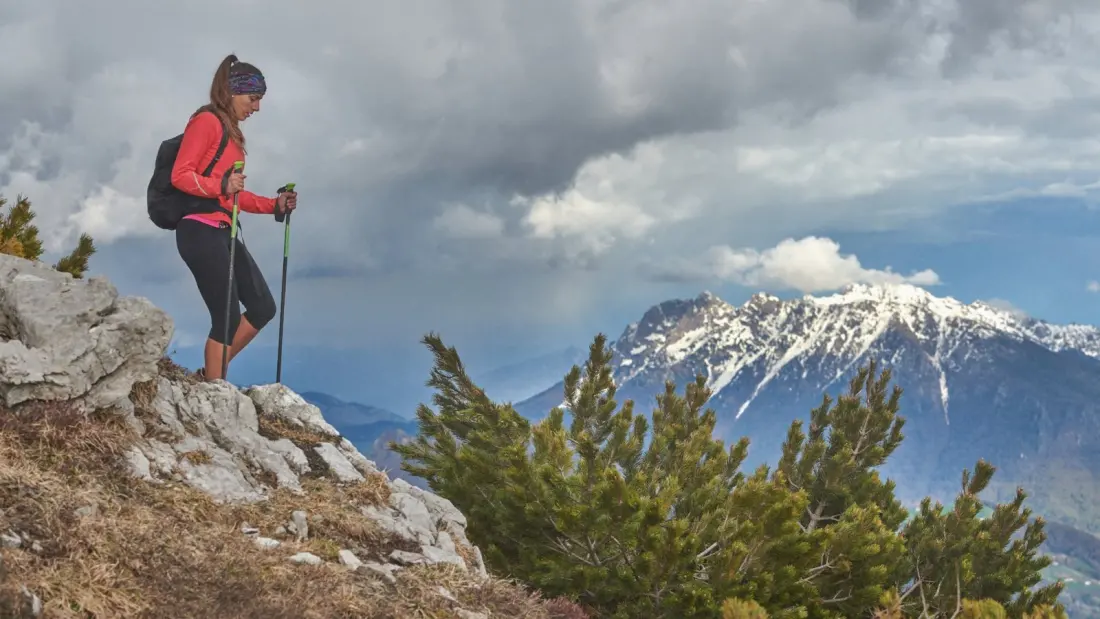
Ever wondered why your heels ache halfway through a long hiking day? A Spanish study suggests the culprit might be the weight you're carrying — and the safe limit is lower than most of us assume.
Researchers led by Santi García-Cremades, a mathematician and statistics professor at Miguel Hernández University in Elche, Spain, tested 39 recreational hikers staying at a hostel on the Camino de Santiago. Everyone in the group had already walked at least 12.5 miles in the previous 24 hours with a pack, so these were people genuinely out on the trail, not lab volunteers.
Using the Podoprint platform — a flat sensor pad that measures how much pressure your feet put on the ground — the team compared four setups: no pack, the hiker's actual trail pack, a pack loaded with 10 percent of body weight, and one loaded with 20 percent. The results, published in the Journal of Functional Morphology and Kinesiology, were clear. Once load reaches roughly 10 percent of body weight, pressure through the foot starts to shift significantly. At 20 percent, total static plantar pressure was nearly 10 percent higher than walking unburdened, with the heel absorbing much of the extra force.
The practical takeaway: a 180-pound hiker should keep their pack to about 18 pounds. That's a genuinely tight budget once you add water, food, and shelter, which is exactly the point — every extra item has a measurable cost.
What does that extra pressure actually do? Dr. Gabriel Cooper, a New York podiatrist at the Icahn School of Medicine at Mount Sinai who wasn't involved in the research, points to a range of problems: blisters on the easy end, plantar fasciitis and ulcers further along, and stress fractures in hikers with osteoporosis. For people with diabetes, a simple blister can turn into a dangerous ulcer; flat-arched hikers may find heavy packs trigger flare-ups sooner. Bad enough injuries can sideline a hiker for six to eight weeks — a trip-ender by any measure.
The study isn't bulletproof. It was small, participants wore their own footwear, and everything was measured on flat ground rather than inclines, where real hiking loads the body differently. Still, the core message stands up: keeping packs light is a straightforward way to protect your joints.
For anyone planning a long-distance walk — the Camino, a hut-to-hut route in the Alps, a thru-hike attempt — this is worth factoring in before you pack. Weigh your loaded bag, not just guess. If you're over the 10 percent line, cut redundancy: fewer spare clothes, smaller toiletries, a lighter sleeping setup. Your heels will thank you by day three.
Story via Outside Online.