After 486.7 miles and 35 days on foot, the last 12 miles into Santiago de Compostela are done. The final stretch from O Pedrouzo starts with a quiet coffee and a forest path lined with mossy stone walls, before the trail suddenly fills with weekend walkers bussed in for the last leg — a reminder that the final 100 kilometres is by far the busiest section of the Camino Francés.
Some of the route's most atmospheric walking happens here. Centuries of pilgrim traffic have worn an earthen trench through the woods, with banks rising 15 to 20 feet overhead. Higher up, a eucalyptus forest has been recently clear-cut — giant stumps across the hillsides — but the loss of canopy opens up broad views over the valleys.
The trail passes Santiago-Lavacolla Airport, the arrival point for many pilgrims, and drops through Lavacolla, where medieval travellers historically washed themselves in the creek before entering the holy city (the name translates roughly to "wash private parts"). Then comes Monte de Gozo, the Mount of Joy, where pilgrims have caught their first glimpse of the cathedral towers for centuries. From there it's a three-mile descent into the city.
Emerging into the Praza do Obradoiro, the granite square facing the cathedral, is the emotional payoff: on this day alone, more than 2,000 pilgrims arrived from routes across Europe, and the square was a mix of tears, laughter and dancing. The writer celebrated with their trail family — the friends accumulated over weeks of walking — before checking into an albergue tucked into an ancient stone building right beside the cathedral, with two-foot-thick walls and a window looking straight up at a bell tower.
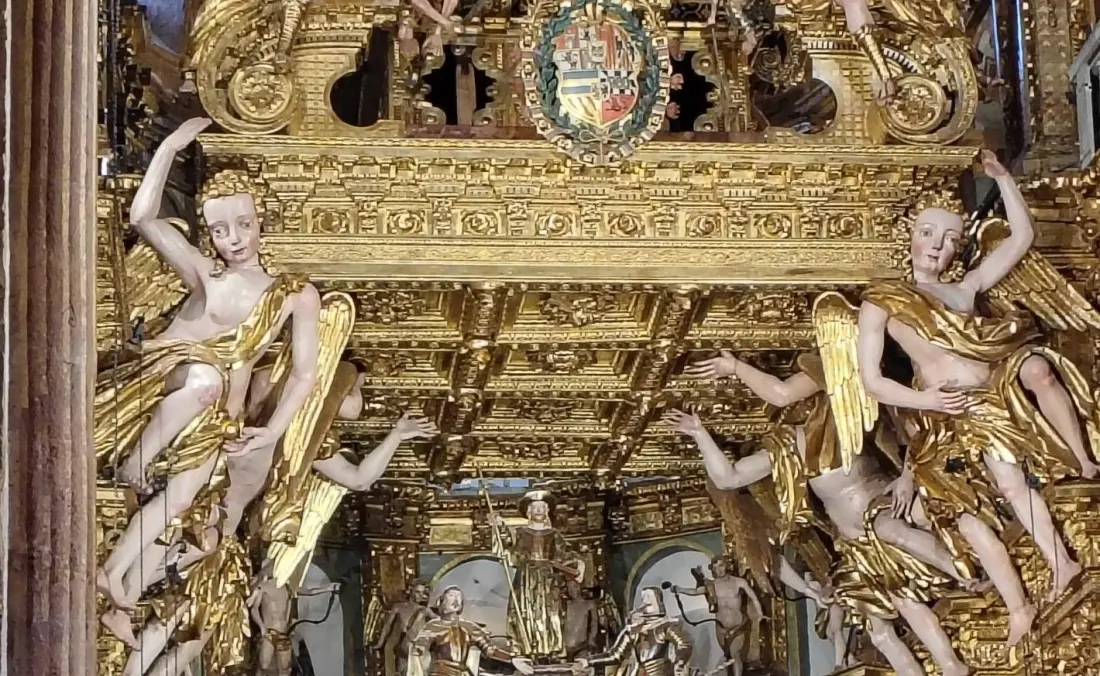
Evening brings the 7:30 PM Pilgrim Mass. Arriving an hour early secures seats near the transept in the hope of seeing the Botafumeiro, the 116-pound silver incense burner that swings dramatically from the ceiling during special liturgies — though it doesn't swing at every service. The mass itself, followed by a visit to the crypt of Saint James beneath the main altar, is what many pilgrims come for.
The journey doesn't necessarily end in Santiago. The writer plans a rest day, then continues west to Finisterre, where the Camino traditionally reaches the Atlantic Ocean — an extra 90 km extension that's increasingly popular with walkers who want to finish at the sea rather than the city.
For travellers considering the Camino Francés, this account captures what the finish actually feels like: a crowded but beautiful final week, an airport conveniently close to the end, accommodation options ranging from budget albergues to apartments in the old town, and a daily pilgrim mass that anchors the whole experience. It's a long walk, but the infrastructure — stamped pilgrim passports, marked trails, a steady supply of food and beds — makes it one of the most accessible multi-week treks in Europe.