
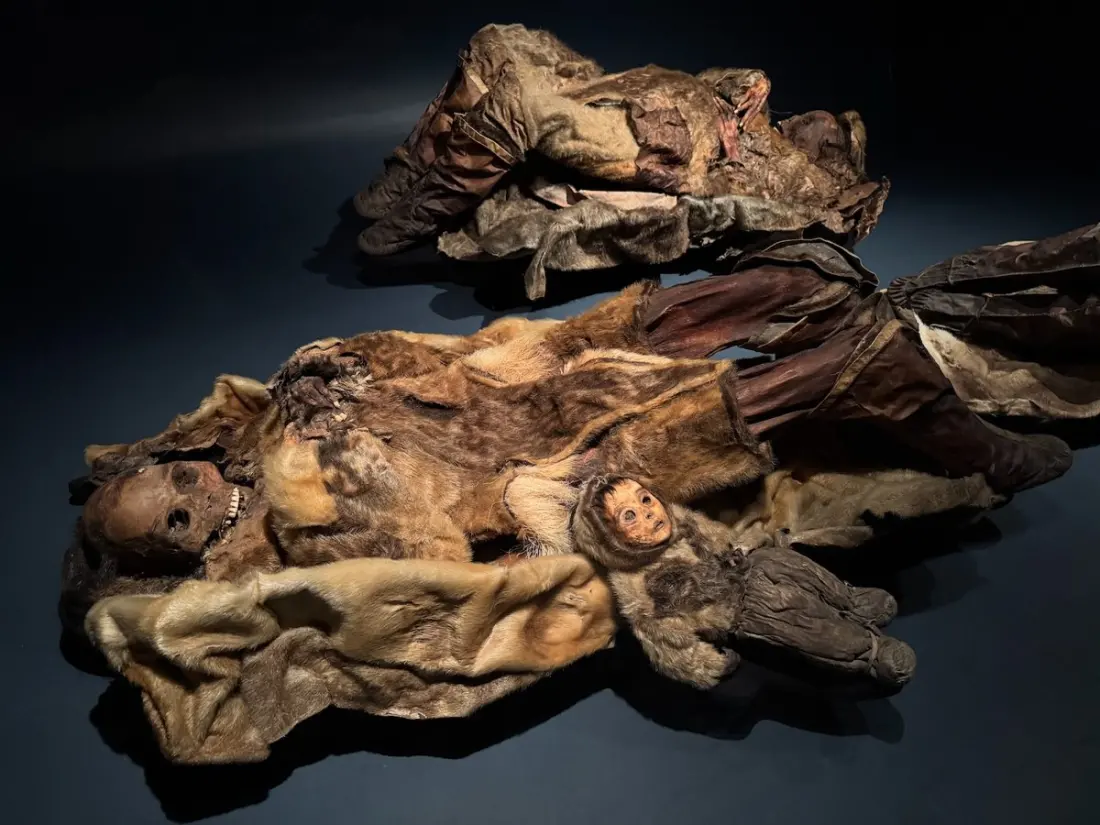
Greenland can feel like a landscape without much human story — vast ice, few roads, tiny settlements. The Greenland National Museum and Archives in Nuuk is the fastest way to fix that. Set in a cluster of historic buildings right beside the colonial harbour, it's not a huge museum, but it traces the island's full human arc, from the first migrants out of North America to the self-governing society of today.
The headline fact most visitors pick up here: Greenland's story is a series of arrivals, vanishings and returns. The first known inhabitants crossed from North America around 4,500 years ago — cultures archaeologists label Independence I, Saqqaq and later Dorset. They managed to survive in brutal conditions, yet several of these populations died out entirely, leaving the island empty for stretches of time.
Then comes the twist. Erik the Red and his Norse settlers arrived around 985, centuries before the ancestors of today's Greenlanders. The Norse farmed livestock, built churches, traded walrus ivory with Iceland and Norway, and at their peak numbered several thousand. The Thule people — the direct forebears of modern Greenlandic Inuit — only began moving east from Alaska and Canada around 1200, bringing boats, weapons and hunting techniques far better suited to the Arctic. For roughly 200 years the two groups shared the island. By the mid-1400s the Norse were gone, with climate shifts, isolation, trade collapse and disease all likely implicated. The Inuit stayed, because their way of life simply worked better.
Europeans reappeared in 1721, when Danish-Norwegian missionary Hans Egede sailed in hunting for the lost Norse and any surviving descendants. He found Inuit communities instead, and in 1728 founded Godthåb — today's Nuuk. From there the exhibits follow Greenland into Danish colonial rule, integration into the Kingdom of Denmark in 1953, Home Rule in 1979, and the 2009 Self-Government Act, which recognised Greenlanders as a people with the right to self-determination.
The collection itself covers archaeology, traditional clothing, skin boats, tools and art, and it does a genuine service: it gives context to the Nuuk you see outside the door. Greenland stops being an abstract icy blob on a map and becomes a place with a specific, layered identity — neither simply Inuit nor simply Danish.
For travellers, this is an easy half-day that pays off for the rest of a trip. Whether you're heading on to see icefjords, dog sled territory or small coastal settlements, an hour or two here explains how humans have repeatedly managed to live at the top of the world — and why some versions of that experiment failed. Entry is straightforward from central Nuuk on foot, and the harbourside location means you can pair it with the old colonial quarter and the waterfront in the same visit.