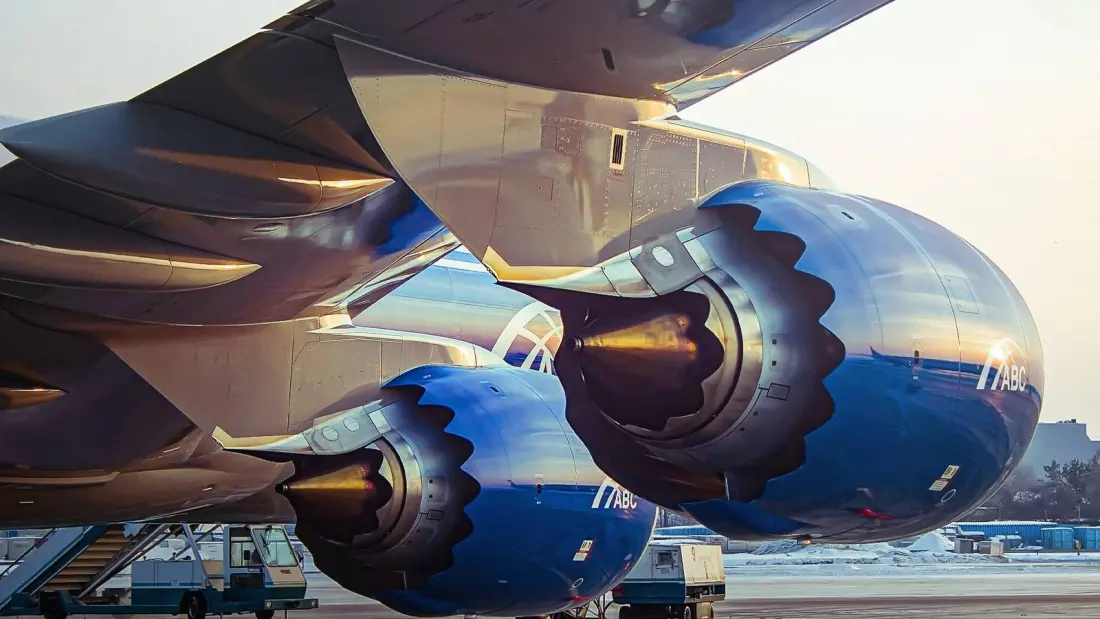
Boeing's biggest jumbo and its composite long-haul star share more than a badge. Both the 747-8 — the final version of the double-decker — and the 787 Dreamliner run on GE's GEnx turbofan family. But they're not identical engines: the 747-8 exclusively uses the GEnx-2B, while the 787 is the only airliner ever fitted with the GEnx-1B. You can spot the family resemblance from the gate thanks to the serrated chevrons on both nacelles, which mix hot exhaust with cool air to cut noise.
The two variants share a common core and roughly 80% of their line-replaceable units, which is a quiet win for airlines that fly both types: fewer spare parts, simpler training, streamlined maintenance. GE's design also keeps the engines on wing about 20% longer than the CF6 units they replaced — some have passed 30,000 hours without a major shop visit — and burns around 15% less fuel.
The differences come down to architecture. The 787 is a bleedless aircraft: most of its systems run on electricity, so the GEnx-1B is built around a more-electric design and packs serious punch — up to 80,400 lbf of takeoff thrust, needed because a twin has to climb out safely on one engine if the other fails. The 747-8, with four engines and older pneumatic systems, takes the GEnx-2B: smaller fan (105 inches versus 111), a simpler internal layout, conventional bleed air for pressurization and anti-icing, and about 66,500 lbf of thrust spread across four engines.
Those engineering choices explain why the two aircraft have had very different commercial fates. The all-aluminium 747-8 burns roughly 3,800 gallons of fuel an hour against the 787's 2,900, and manages about 2.82 litres per 100 km per passenger versus the 787-9's 2.31. Passenger orders for the jumbo dried up — production for the type ended in 2017, and the 747 line closed entirely in 2023. The Dreamliner, meanwhile, became the best-selling widebody ever, letting airlines open nonstop point-to-point routes that a four-engine giant could never fill profitably.
For travellers, the 787's advantages are felt at seat level. Its composite airframe (50% of the aircraft by weight) allows a cabin altitude of 6,000 feet instead of the 747's 8,000, double the humidity, bigger windows and dimmer, more natural lighting — all of which take the edge off long-haul fatigue. A turbulence-damping 'smooth ride' system rounds it out, and the same tech is due on the 777X when that aircraft debuts in 2027.
Carriers have voted with their order books. Lufthansa uses the 787-9 on routes needing 747 range with 70-90 fewer seats, keeping load factors healthy off-peak, while British Airways moved flagship transatlantic services to New York and Chicago onto the 787-10 — 25% more fuel-efficient than the jumbo it replaced — after retiring its 747 fleet. United, similarly, is consolidating on the 787 to replace a mix of 747s, 767s and early 777s.
The Queen of the Skies had a legendary run, but the engine story shows exactly why the Dreamliner defines long-haul flying now.