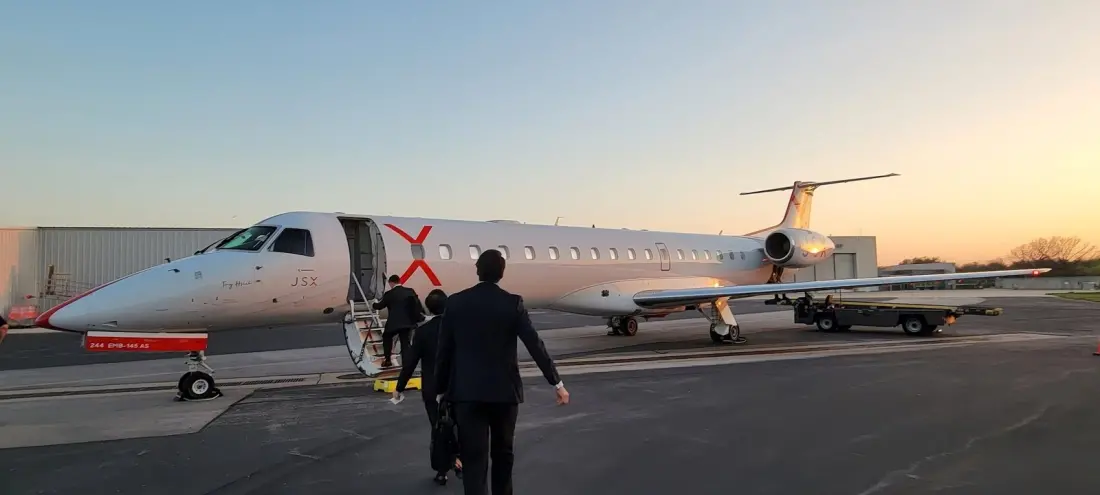
Boutique carrier JSX has quietly bought New Pacific Airlines, a failed startup it may revive with 42-seat Embraer regional jets. That's 12 more seats per plane than JSX flies today, and it hands the company a way to grow past the ceiling built into its current operation.
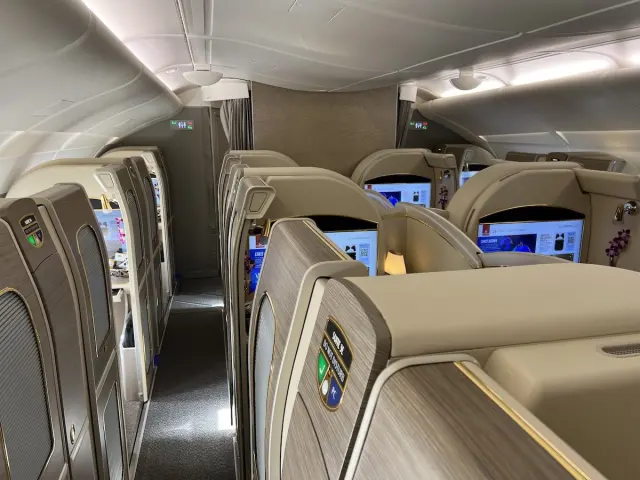
Here's the context. JSX built its following on a simple promise: skip the big airport. You arrive about 20 minutes before departure, board at a private terminal, sit in a roomy 30-seat cabin with a seat on each side of the aisle, and often get Starlink Wi-Fi in the air — it was the first airline to outfit its whole fleet. Fares cost more than mainline economy, but not dramatically so, and the time saved is the real product. The company has been creative about airport access too: it put 30-seat turboprops on Santa Monica's shortened runway, and at Teterboro — where advertised scheduled service is banned — it gates bookings behind a free Club JSX membership login. United Airlines also holds a stake in JSX.
New Pacific, formerly Northern Pacific, once planned to link the US mainland and Asia via Anchorage with Boeing 757s, a plan effectively killed when Russia closed its airspace to US carriers. It pivoted to short domestic hops and charters, then shut down last November. What JSX inherits is not the 757s (lost in bankruptcy) but the airline's Part 121 certificate — the full scheduled-airline certification that permits aircraft with more than 30 seats, unlike JSX's current public-charter model.
The filings give a hint of scale: two Embraer ERJ145s at launch, six by month five, around 10,100 flights and roughly 309,000 passenger boardings in the first year, with flights averaging about 1.2 hours gate to gate. JSX itself isn't saying much yet, offering only that it's pursuing pathways to bring its service to more customers and communities.
There's a regulatory subplot. American Airlines, Southwest and the pilots' union ALPA have lobbied to restrict JSX's charter-based model, so holding a Part 121 certificate looks like insurance if the rules change. It may also be a genuine growth plan: 42-seat cabins would still be far roomier than a standard 50-seat regional jet, and federal security rules allow 31-to-60-seat scheduled flights to use private terminals. The switch isn't friction-free, though — Part 121 brings stricter pilot requirements including mandatory retirement at 65, which rules out the senior ex-airline captains JSX relies on, and some current airports would need new certification to qualify.
For travellers, the takeaway is that the semi-private flying niche is expanding rather than consolidating. If JSX runs 42-seat jets under a scheduled certificate, expect more cities to get the arrive-late, skip-the-queue treatment, likely at a slightly lower price point than today's 30-seat product. Anyone who values an airport experience measured in minutes rather than hours should watch which routes New Pacific starts up on.
View from the Wing