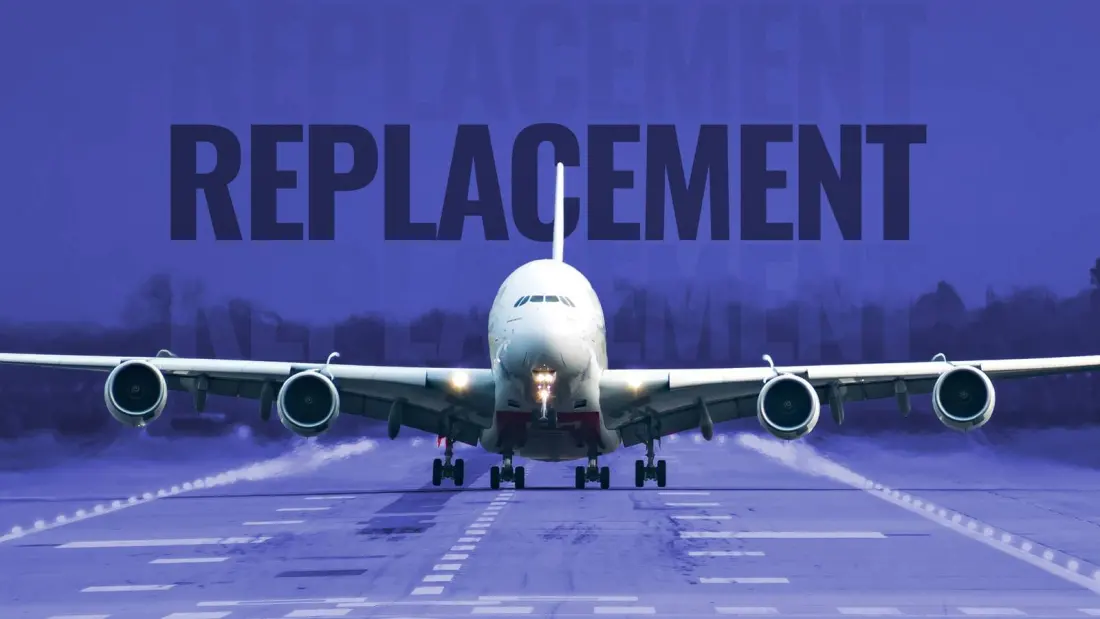
The Airbus A380's production line went quiet in 2021, and with Airbus refusing to revisit the programme, the double-decker era is winding down. Emirates — which flies more than 100 of the type, roughly half of all built, from a Dubai hub purpose-built for the plane — will keep its superjumbos going for years yet. But the aircraft set to inherit high-density, long-haul routes is Boeing's 777X, the largest twinjet ever designed, which is slated to enter service in 2027.
The numbers tell the story. A typical A380 carries 500-600 passengers, and the type is certified for more than 800 in an all-economy layout. The 777X, by comparison, seats around 400-415 in a standard configuration — close to the Boeing 747-8 it also succeeds, but well short of the Airbus. What the new jet loses in raw capacity it makes up in economics: two engines instead of four, simpler maintenance, lower fuel burn, and the flexibility to serve airports that can't handle the A380's weight or noise footprint.
Those engines are the headline act. The GE9X turbofans are the most powerful ever fitted to a commercial aircraft, with a record 134,300 pounds of thrust measured in testing — nearly matching the combined output of the A380's four GP7200s or Trent 900s. For airlines squeezed by emissions rules and the shaky economics of filling 600 seats every flight, that efficiency is the whole point.
Passengers get something out of the swap too. The 777X cabin is four inches wider than the current 777, with windows 17% larger and optional electronic dimming. Cabin altitude is set at 6,000 feet — matching the A380's famously gentle pressurisation and beating the industry-standard 8,000 feet — and humidity is double that of today's 777, which should mean less jet lag and fresher arrivals on long-hauls. Boeing has also reworked the air conditioning and insulation for a quieter cabin.
One detail airlines care about: the 777X's modular interior. Carriers can reconfigure seats, suites, galleys, lavatories and crew bunks as demand shifts between premium-heavy long-haul layouts and high-density configurations. For operators like Emirates and Qatar Airways — both A380 stalwarts and major 777 customers — that adaptability protects the lavish first-class products that define their brands.
Will it match onboard bars and showers? No. Nothing truly replaces the A380's theatre. But for travellers, the practical takeaway is this: the mega-plane routes you fly today — think Dubai, London, Singapore — will still get big, comfortable aircraft after the superjumbo retires. They'll just be quieter, roomier-feeling twins rather than double-deckers. Expect the transition to begin in earnest once the 777X arrives in 2027.