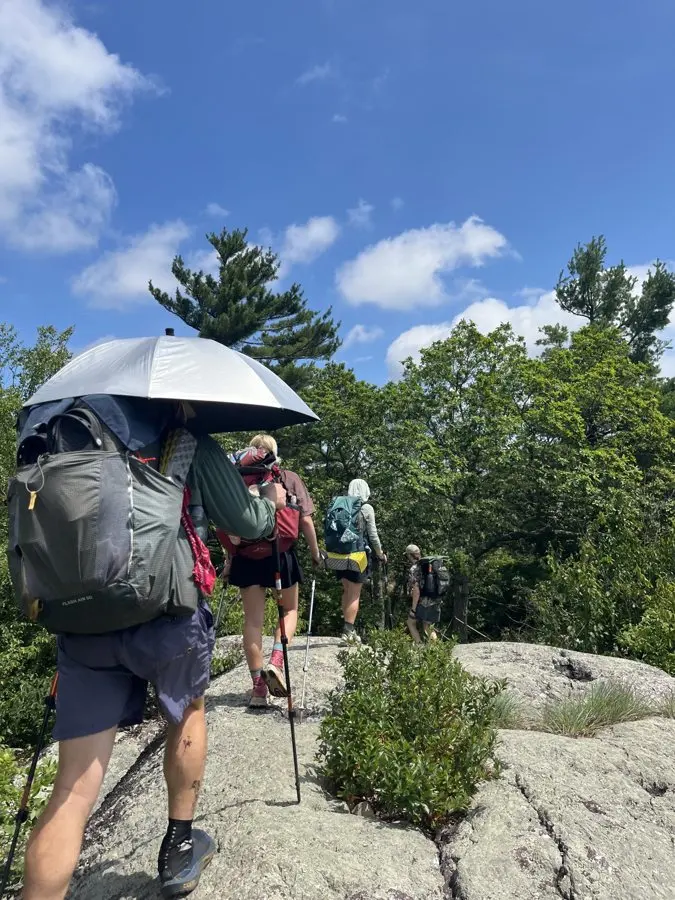
A six-ounce umbrella sounds like a gimmick — until you've spent a week hiking in muggy, drizzly weather and would trade anything for a dry patch of air in front of your face. On America's western trails, sun umbrellas have gone mainstream: on shade-free desert routes like the Pacific Crest Trail and Arizona Trail, they're a common way to make your own shade. The question for east coast hikers is whether the same trick works on the Appalachian Trail, where the enemy isn't sun but rain.
The argument for is simple. The AT is famously wet, and much of the time it rains lightly or warm — conditions where a rain jacket does more harm than good, trapping sweat and heat. An umbrella lets you keep hiking in a shower without a shell, staying drier without adding your own moisture to the mix. Because most hiking umbrellas weigh only about five to seven ounces (the Snow Peak Ultra-Light comes in at 4.7 oz, Gossamer Gear's Lightrek at 5.7 oz, Six Moon Designs' Silver Shadow Carbon at 6.8 oz), the penalty for carrying one is small. Some 2025 thru-hikers swear by them for exactly this reason — one described it as 'a little bit of controlled dry space in front of your face' during downpours, letting her hike jacket-free with headphones on.
The case against comes down to terrain. Much of the AT runs through dense forest — the so-called green tunnel — where low branches, overgrown growth and rhododendron tunnels make a wide umbrella awkward in a way it never is on open western routes. And unlike those gently graded desert trails, the AT is steep, rocky and rooted; most hikers keep trekking poles in hand at all times, and through New Hampshire's Whites and southern Maine, rock scrambling makes umbrella use flatly impractical. Hands-free clips exist but are fiddly to angle and adjust. Humidity undermines the sun-shade benefit too: in moist eastern air, shade is only a few degrees cooler than sun, so you won't gain much there anyway.
The verdict from long-distance hikers: it's a legitimate luxury item, not an essential. Bring it for rain, not sun, and accept it'll only improve some of your days. If shaving every gram matters more than comfort in drizzle, skip it. If a few ounces buys you happier miles through a wet summer, it's a cheap upgrade. Either way, a proper rain jacket or poncho remains non-negotiable — heavy rain and wind will send the umbrella straight into your pack.
For anyone planning an AT section hike or thru-hike this year, the umbrella question is a nice small illustration of a bigger truth: gear lists built for western trails don't always translate east. Test your setup on humid, tree-lined terrain before committing.