
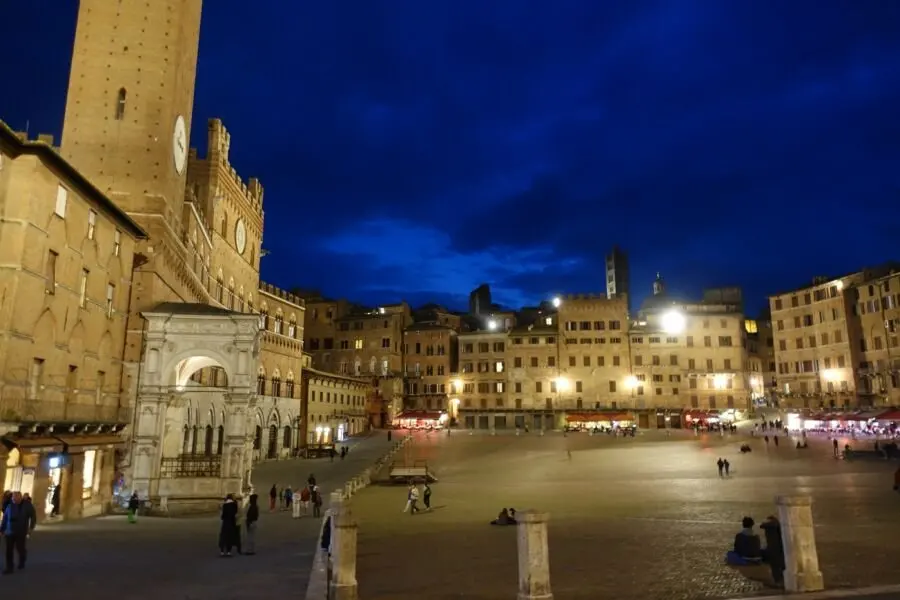
Tuscany has plenty of postcard towns, but Siena plays a different game. Perched on a hill south of Florence, it's a brick-and-tile time warp that never got around to modernising — and travellers are all the richer for it. In its 14th-century prime, Siena ranked among Europe's biggest and most powerful cities alongside Florence, Venice and Genoa. Then plague and Florentine conquest turned it into a backwater. That political irrelevance froze its Gothic streets in place, giving today's visitor what's arguably Italy's most immersive medieval experience.
Start at Il Campo, the shell-shaped main square where a sloped red-brick floor fans out from the City Hall tower. It's built for doing very little: sit, snack, people-watch. Rick Steves rates it the finest piazza in Europe, and the logic holds — unlike most Italian main squares, it's framed by civic buildings rather than a church, a nod to Siena's old civic pride. Climb the roughly 100-yard bell tower for a rooftop panorama, then step inside City Hall to see frescoes, nearly seven centuries old, contrasting the blessings of good government with the chaos of bad ones.
A few blocks away, on the city's highest point, the Duomo justifies every crowd you'll wade through. The striped white-and-green cathedral is Gothic maximalism, stuffed with statues, mosaics and busts of more than 170 popes ringing the interior. Look for the marble pulpit carved by Nicola Pisano in 1268, plus works tied to Michelangelo and Bernini.
When the centre gets busy, get deliberately lost. Siena's back lanes are dotted with iron horse-tethering rings and flags representing the contrade — the fiercely loyal neighbourhoods that battle it out in the Palio, the bareback horse race that transforms Il Campo twice each summer into a packed, chaotic racetrack. Food shops tempt along the way: artisanal pasta, aged Chianti, boar prosciutto and panforte, the dense, chewy nut-and-honey cake whose spice blend some local bakeries guard with NDAs. Recipes supposedly go back to the 13th century.
The smartest way to end a day here costs nothing: wait out the tour buses, join the evening aperitivo (many bars include a free buffet) and drift back to Il Campo for the twilight moment when the sky turns the same deep shade as the medieval towers.
Siena suits travellers who'd rather wander than tick boxes — history buffs, slow-food fans and anyone happy trading big-name museums for atmosphere. It works as a day trip from Florence, but staying overnight is when the city really belongs to you.