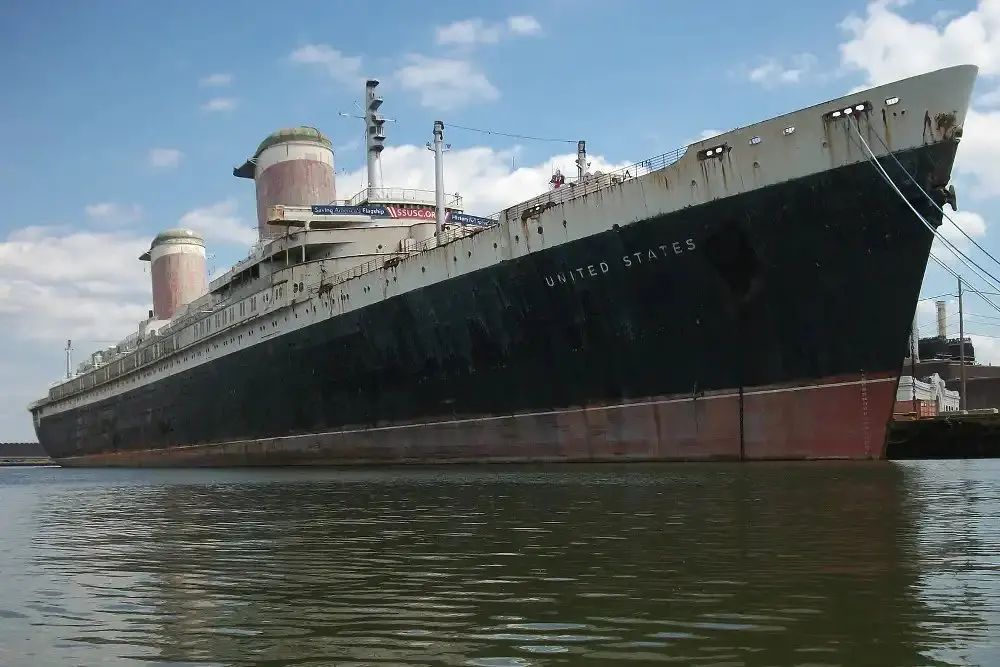
The SS United States — the 302-metre ocean liner that still holds the transatlantic speed record — is set to be scuttled off Florida in the second week of November, becoming the largest ship ever deliberately sunk to form an artificial reef.
Okaloosa County officials have confirmed the vessel will rest on the seabed roughly 25 miles southwest of Destin-Fort Walton Beach, in about 55 metres of water. Her upper decks should sit at around 17–18 metres, shallow enough for recreational divers, while the deeper sections will suit technical divers. The exact date depends on weather.
The ship's story is one of the great maritime rise-and-falls. Launched in 1951 and designed to double as a military transport, she smashed the Blue Riband on her 1952 maiden voyage, crossing the Atlantic in 3 days, 10 hours and 40 minutes — beating RMS Queen Mary's 14-year-old record by more than ten hours. Jet aircraft ended her career in 1969. After decades laid up in Norfolk and Philadelphia, various redevelopment schemes came to nothing, and a rent dispute with her Philadelphia pier owners forced her out in September 2024. Okaloosa County stepped in with a reported $1 million plan to turn her into a reef, and she was towed to Mobile, Alabama in early 2025 for preparation.
That prep is now essentially done. All 128 fuel and lubricant tanks have been emptied and certified safe, PCB-laden paint and deck coverings stripped, and every one of her 12 decks inspected. The US Army Corps of Engineers has renewed the county's artificial reef permit, and sonar surveys of the deployment site are complete. Her red, white and blue funnels, propellers, radar mast and some 400 portholes have been removed — many destined for a planned land-based museum honouring the ship.
Divers will notice a thoughtful approach to the sinking itself. Rather than explosives, she'll go down by controlled flooding, designed to settle upright, with access holes cut for marine life and divers and unsafe compartments sealed off. A digital model of the ship has been created to record her condition before deployment, and marine science researchers plan to monitor the reef's ecological impact afterwards.
For divers and anglers, this is a big one. She'll easily surpass the aircraft carrier USS Oriskany — sunk off Pensacola in 2006 and currently the reigning giant of purpose-sunk reefs. The county expects the wreck to become a cornerstone attraction for the region's dive and fishing trades, and the Conservancy has promised a public livestream of the sinking once the final date is locked in.
If you've ever wanted to dive a piece of maritime history, November in the Florida Panhandle is the window to watch for. Full story via Dive Magazine.