A three-man Russian expedition has abandoned its second attempt on Everest's little-climbed West Ridge, retreating to Base Camp sick and drained after just two days on the mountain.
Andrei Vasiliev, Serguey Kondrashkin and Vitaly Shipilov returned to the Lho La — the col on the Nepal-Tibet border that gives access to the ridge — on October 20. They camped on the plateau beyond it and planned to fix more rope higher up the route, which they had already partly scouted on an earlier rotation. Weather was on their side: sunny skies and light winds, though bitterly cold.
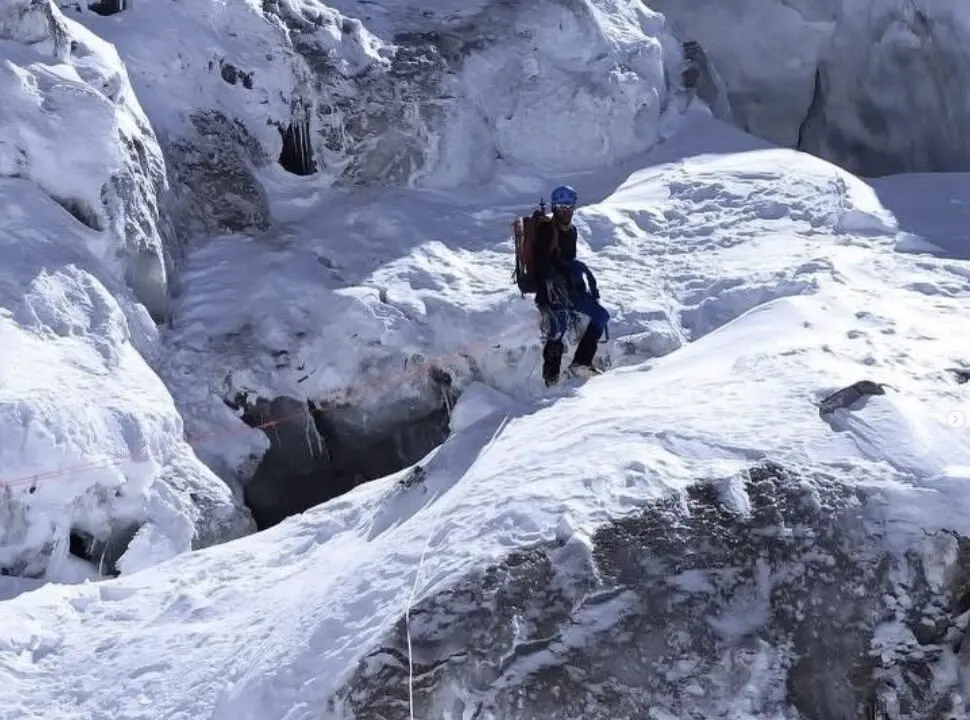
Progress, however, was painfully slow. Team messages home, relayed through expedition member Natalya Belyankina (who herself had to leave the trip due to illness) and Anna Piunova of the Mountain Club, described heavy packs and a persistent cough slowing the climbers to a crawl. Leader Vasiliev was blunt about the terrain: steep snow slopes hiding rock sections underneath, with nothing straightforward about the line.
The plan for Wednesday was ambitious — climb to 7,500 metres, overnight there, scout the route ahead, then drop back to the plateau. It never happened. The team fell well short of its target, and worse, found no viable bivy spot at their high point, forcing them to descend to somewhere a tent could actually be pitched. By Thursday, the call was made. 'We're sick and need to recover,' Vasiliev reported. 'We can barely keep moving.'
The West Ridge is one of Everest's great unsolved lines by modern standards — first climbed in 1963 by Americans Tom Hornbein and Willi Unsoeld, and attempted only rarely since. It demands sustained technical climbing at extreme altitude, which is precisely what the Russians ran into: even familiar sections of the route fought back, and at 7,000-plus metres illness compounds fast.
For the adventure-minded reader, the story is a useful reality check. Everest's 'standard' routes via the South Col and North Col are busy, fixed-line highways by comparison; the West Ridge is a different animal entirely, suited only to small, self-sufficient teams with prior Himalayan experience and a flexible weather window. The Lho La approach itself, from the Tibetan side via Rongbuk, remains one of the more dramatic viewpoints in the Himalaya — and trekkers heading to Everest Base Camp on the north side can glimpse the terrain these climbers were tackling.
Whether the Russians regroup for a third push this season depends on how quickly they shake off the coughs and exhaustion at Base Camp, and how long the autumn weather holds. Himalayan autumn windows close fast in November, so their time is running out. Either way, the ridge has now beaten them twice — a reminder that on Everest, the harder lines have not gotten any easier.