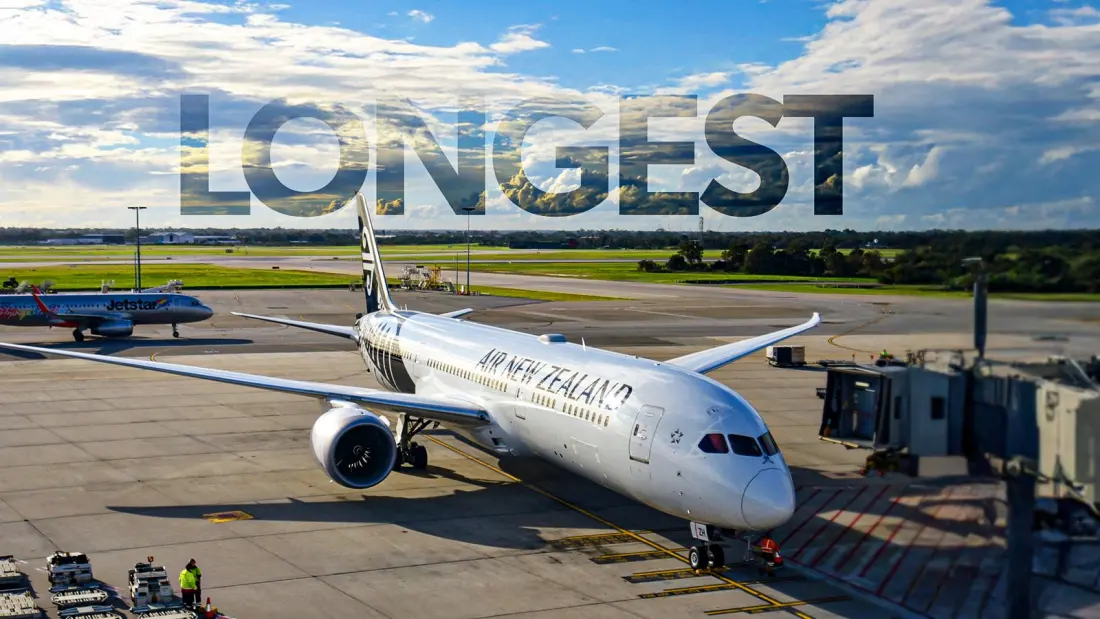
The Boeing 747 once ruled ultra-long-haul flying, but its 400-seat bulk made the world's longest routes financially fragile. Enter the 787-9 Dreamliner: a twinjet that can fly more than 7,800 nautical miles (14,400 km) with just 220-300 seats while burning far less fuel. It's not the longest-range airliner out there - that's the Airbus A350 - but its blend of range and efficiency has quietly reshaped how airlines connect the planet's farthest corners.
So where is the type flying the farthest in 2026? Counting down from seventh: United's San Francisco-Singapore service covers 7,340 nautical miles and became the first route to receive United's new premium-heavy 787-9 layout, with 64 Polaris suites in a 222-seat configuration. Qantas's Sydney-Dallas/Fort Worth (7,454 nm) usually runs on an A380 instead, since the partner-hub demand can fill all 485 seats.
At number five is United's Houston-Sydney flight (7,470 nm), still the longest route operated by any US airline since its 2018 launch, now served daily from late October to March. Air New Zealand's Auckland-New York JFK route (7,671 nm) holds the NZ1 flight number but has reportedly lost money - Qantas entered the same city pair in 2023 with more frequencies, better feed and a more premium cabin. Air New Zealand is countering with new, premium-heavy 787-9s seating just 214-219 passengers.
Third place goes to Qantas's Perth-Paris route (7,702 nm), launched in 2024 as the third link in Qantas's Perth-to-Europe strategy after London and Rome. Middle East airspace restrictions mean the outbound leg now stops in Singapore, though the return still flies nonstop. Second is Melbourne-Dallas/Fort Worth at 7,814 nm, Qantas's longest US route, made viable largely by the metal-neutral joint venture with American Airlines.
The longest of all is Perth-London Heathrow at 7,829 nautical miles. When Qantas launched it in 2018 - the first-ever nonstop between Australia and Europe - sceptics wondered if anyone would endure 17-plus hours airborne rather than break the journey in Singapore or Dubai. Passengers did, and the route outperformed much of Qantas's network. Even so, the 236-seat 787-9 frequently hits payload limits, which is why Qantas eventually plans to swap in its Project Sunrise A350-1000ULR with greater cargo capacity and more premium seating.
For travellers, this list is essentially a menu of one-seat, no-stop journeys that simply didn't exist a decade ago. Australia to Europe nonstop, Texas to Sydney nonstop, Auckland to Manhattan nonstop - all are now routine, and most are served by planes with substantially more business and premium economy seats than before. If you're booking one, it's worth checking which configuration your flight uses: on United and Air New Zealand especially, the newer subfleets offer a noticeably more premium experience in every cabin.