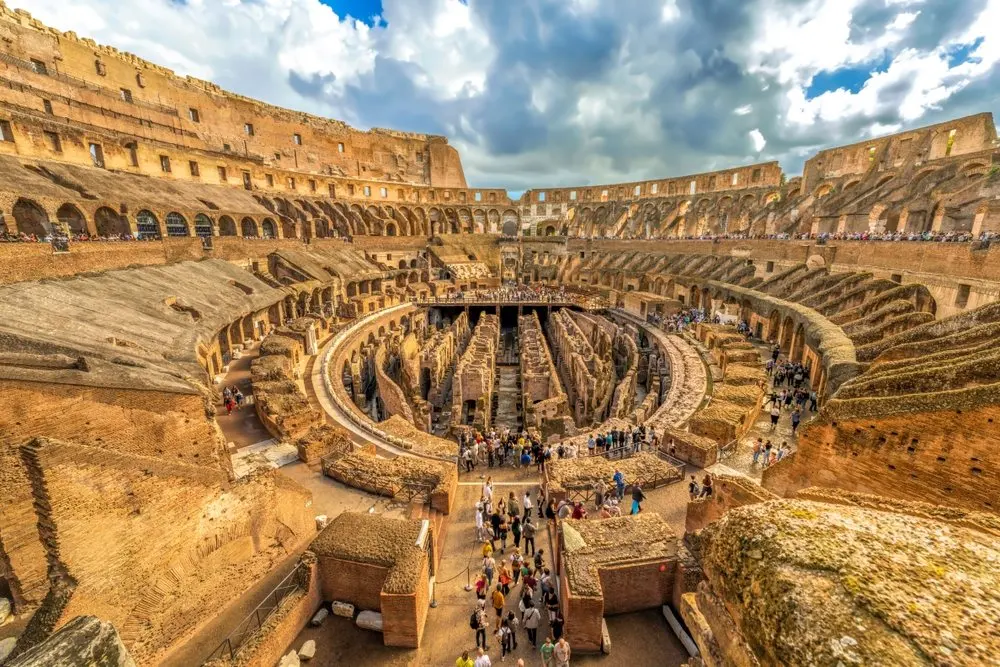
Nearly every photo of the Colosseum's interior shows the same strange sight: no floor. Where gladiators once fought, there's an exposed maze of brick walls and tunnels, open to the sky like the guts of a stripped-down machine. What most visitors don't realise is that this iconic image is modern — and ancient Romans would never have recognised it.
The original arena was an oval wooden deck, roughly 83 by 48 metres, topped with a layer of sand. That sand is where we get the word "arena" — harena in Latin. Hidden underneath was the hypogeum, a two-level basement of corridors, cages and vertical shafts. Animals, fighters and stage scenery were hoisted up through hatches using lifts and ramps, so a lion or an entire painted forest could appear centre-stage without warning. The Colosseum was less a stadium than a theatre with heavy-duty stage machinery, and the crowd never saw the crew at work.
So why can we see it now? The wooden floor simply didn't survive the centuries, and in the 1800s archaeologists cleared away the remnants to expose and study what lay beneath. The result is the postcard view we all know — but it was nobody's intention when the building was new.
There's been talk of restoring the floor for years. In 2021, Italy's Ministry of Culture picked a winning design for a retractable wooden floor whose slats could rotate open to reveal the hypogeum, or close to recreate something like the ancient arena view. Crucially, the design is reversible, so it can be removed without damaging the ancient walls.
You don't have to wait, though. A specific arena-access ticket lets you enter through the east gate — the one the gladiators used — and stand on a wooden platform at arena level, right in the middle of the bowl. From there, the building transforms. Instead of a ruin viewed from above, you get the intended effect: steep tiers rising on every side, the emperor's box looking small and distant, and glimpses through gaps into the hypogeum below. It's the moment the building's purpose finally makes sense.
Tickets cost €18 for standard or Only Arena entry, and €24 for the Full Experience Arena. Only Arena visits take about 20 minutes; plan 75–90 for the full site. Opening hours run from 8:30 AM daily, closing between 4:30 PM and 7:15 PM depending on the season, and the Colosseum shuts on January 1 and December 25. Book arena access in advance — it's a timed, ticketed add-on, not something you can sort out on the day. Groups are kept small and the platform is limited, so go early if you can; the morning light is far kinder to the stone.
Anyone heading to Rome and planning the usual Colosseum tick-box visit should consider this upgrade. Standing where the sand was changes the whole story of the place — and it's the closest you'll get, for now, to what a Roman spectator actually paid to see.