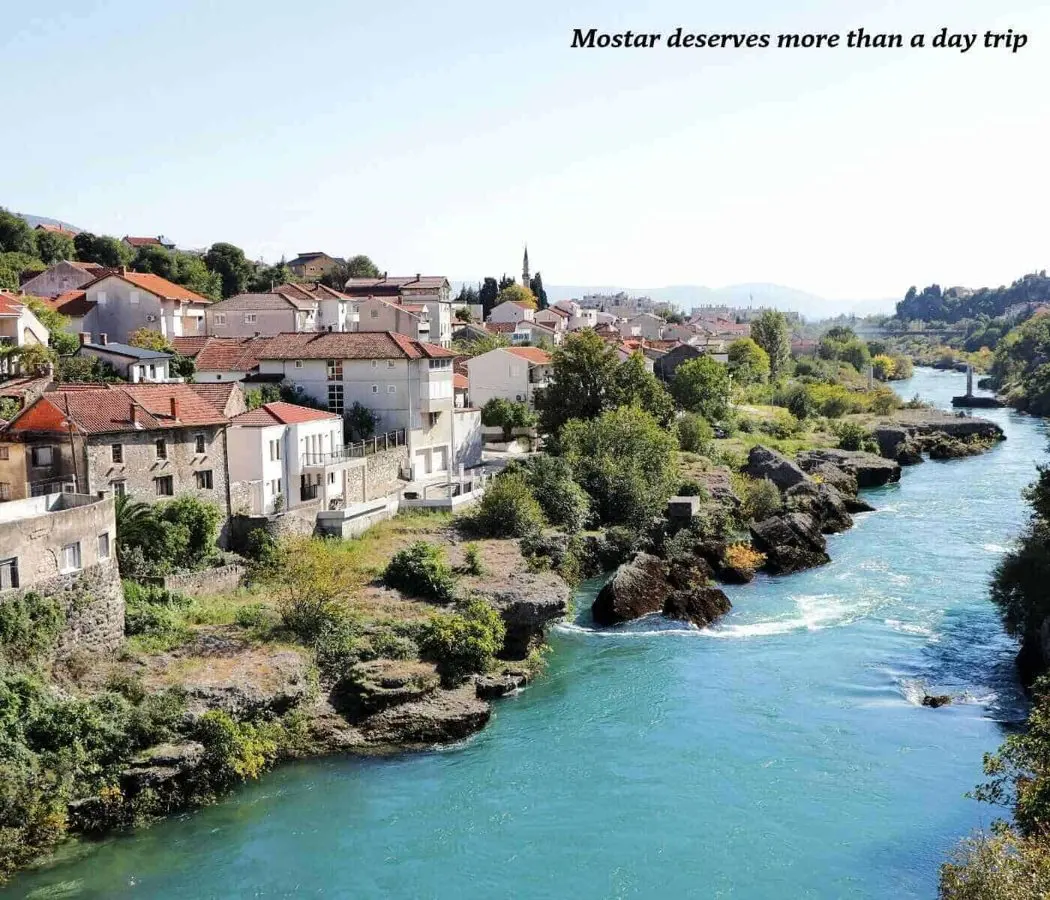
Most tourists roll through Mostar on a coach from Dubrovnik or a stop-off en route to Sarajevo, snap a photo of the Old Bridge and move on. Stay a night or two and you get the city back once the day-trippers leave — plus wine country, ziplines and mountain plateaus on the doorstep.
Start, inevitably, with the Stari most, the single-arch stone bridge over the Neretva River. It's a replica of the original 16th-century span designed by Hajrudin, a student of Ottoman architect Sinan, which stood for over 400 years before being destroyed in the 1992–95 war. In spring and summer, members of the Bridge Divers' Club leap 24m into the river below — a local tradition stretching back 450 years, though these days divers usually want a tip of 60–100KM before they jump. Brave (or reckless) visitors can attempt the leap themselves for around 100KM, training included.
Back on land, the cobbled Kujundžiluk street is the old trading quarter, where coppersmiths, carpet-makers and antique dealers still work their craft, and the uphill stretch offers the classic shot of the bridge. The 1617 Koski Mehmed-Pasha Mosque lets visitors climb the minaret for the best rooftop views in town; modest dress is required and headscarves are provided. For history, the western bridge tower holds a photo exhibition from New Zealand war photographer Wade Goddard, while the Museum of War and Genocide Victims 1992–95 is a sobering but essential look at what Mostar endured. The Stari most Museum in the Tara Tower includes a UNESCO film on the bridge's reconstruction by Bosnian director Jasmila Žbanić.
Two Ottoman-era houses round out the old town. Bišćevića House, propped on 5m pillars above a lane down to the river, is still family-owned and toured by the family themselves. Muslibegović House is arguably the finest 17th-century Ottoman residence in the country — and it doubles as a boutique B&B, so you can sleep like a nobleman. Elsewhere, the Peace Bell Tower at the church of St Peter and Paul soars about 107m; its observation deck costs 10–15KM and delivers arguably the best panorama of the city. For adrenaline, Fortica Adventure Park on the hill above town has the country's longest zipline (570m), a glass Skywalk and a former Italian bunker serving refreshments.
With an extra day, head out: Počitelj, a reconstructed Ottoman village about 30 minutes south on the M17, is a tentative UNESCO site with a long-running art colony; Blagaj's Buna spring, under 20 minutes away, pairs perfectly with a riverside trout lunch; and the quiet Podveležje Plateau at 700m offers shepherding traditions, wind farms and treks to Velež's 1,980m summit. Back in town, skip the tourist-trap restaurants and linger over café culture — Herzegovinian figs, pomegranates and local honey from Tepa Market make good snacks between stops.