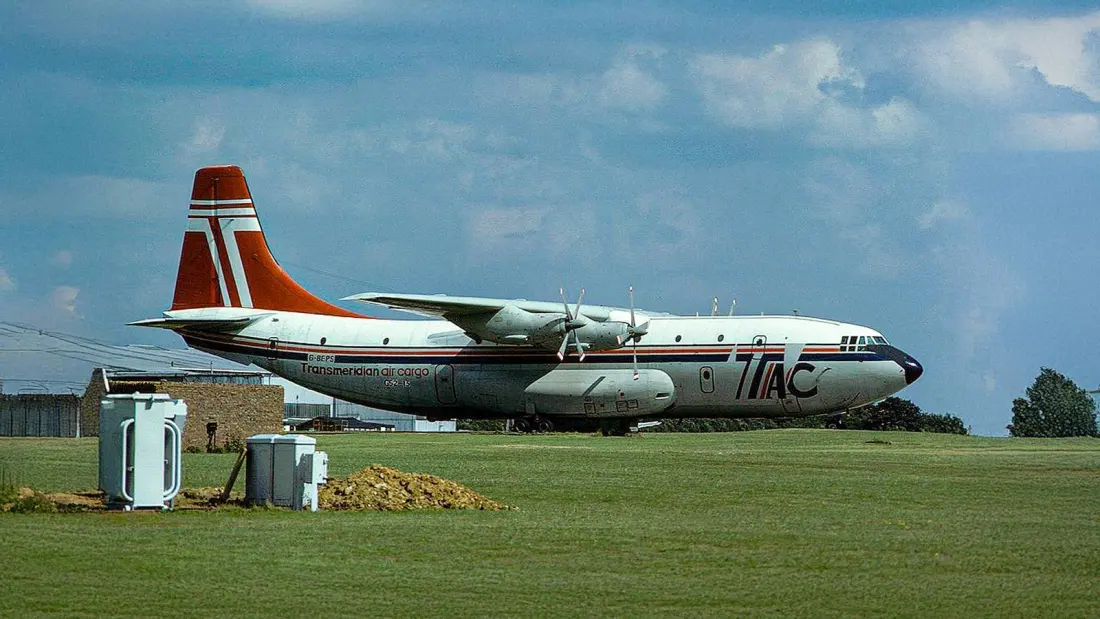
Parked on a tarmac at Cairns Airport in Far North Queensland since 2009 sits one of aviation's great oddities: a Short Belfast, the enormous British Cold War freighter of which only ten were ever built. Nicknamed Hector, this airframe is the last one with any realistic chance of flying again, and its story has taken more twists than most.
The Belfast was a monster. Roughly twice the size of the C-130 Hercules in internal volume, it stretched 136 feet long with a 158-foot wingspan and a pressurised cargo hold wide enough to swallow two buses side by side, with room left for forklifts to work inside. Four Rolls-Royce Tyne turboprops gave it serious muscle — it once carried over 70,000 pounds of medical supplies to Saigon in a single 1968 flight — but heavy loads slashed its range to about 1,000 miles. The RAF retired the fleet in 1976 after barely a decade, a decision historians now call short-sighted: during the 1982 Falklands War the government had to charter civilian Belfasts at rates that eventually exceeded what keeping the fleet would have cost.
Hector's revival looked promising. In late 2023 the aircraft changed hands, was registered in the US as N1819S, and the new owners targeted a return to flight within two years. Engineers overhauled the flight deck and generators, serviced the rare Tyne engines, and even ran them on the tarmac. Then Cyclone Jasper hit. Historic flooding in December 2023 submerged Hector up to its lower fuselage after Cairns took over 12 inches of rain in 24 hours, soaking wiring, landing gear and the lower hull of a 1960s airframe that already faced a parts shortage. No engine runs, damage assessments or airworthiness approvals have surfaced publicly since.
Why does this matter to travellers and avgeeks? If you're plane-spotting in Cairns, Hector is still there on the general aviation apron — a rare photo of a type you'll find nowhere else in flying condition, aside from the preserved XR371 'Enceladus' at the RAF Museum in Cosford, England. And if the restoration ever succeeds, the owner is reportedly eyeing humanitarian and heavy-cargo missions, a niche left emptier by the loss of several Antonov airlifters in recent years. Whether a 1960s analog cockpit can be upgraded to modern airspace standards at a sane cost is the open question.
For now, the Belfast remains a sleeping giant in the tropics — proof that some Cold War machines were simply too big, too specialised and too early for their own budgets.