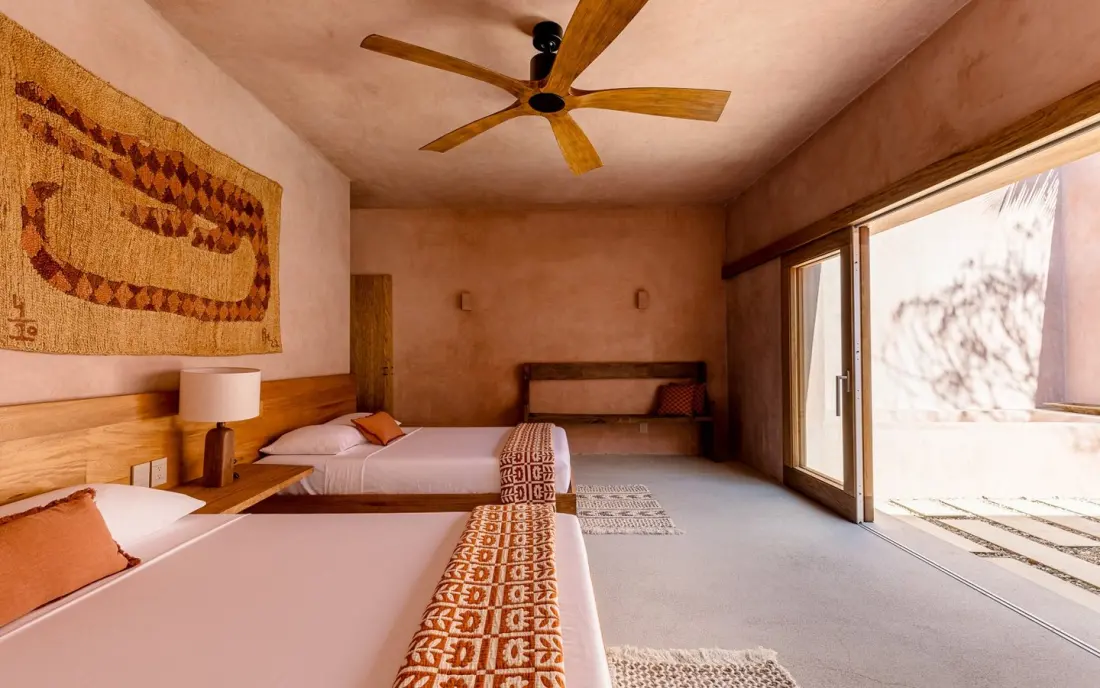
Next time you pad across a hotel bedroom floor at midnight, spare a thought for the rug. According to a recent design feature from Hotel Designs, it is the hardest-working textile in the room: it absorbs more barefoot traffic than any other rug in the building, has to sit comfortably underfoot for the two-hundredth guest as much as the first, and its scale has to answer to the bed above it. Get it wrong and the whole room feels off. Get it right and it either disappears quietly or holds everything together.
The piece, built around British rug studio Pelican House, sets out two schools of thought. The first is the bold move: a rug that matches the room's energy instead of hiding from it. At The Hoxton in Dublin, an olive-and-oxblood bordered rug goes pattern for pattern with a busy checkerboard headboard. Kin House takes the same approach from the floor up, with a red-and-cream checkerboard running right to the edge of a canopy bed, anchoring the room rather than sitting beneath it.
Then there is the restrained option. In designer Emma Ainscough's Chelsea bedroom, a pale rug scattered with tiny florals sits under a deep green headboard, so understated you would only register it if it were gone. At Casa Coco in Oaxaca, Mexico, that same quietness moves onto the wall, with hand-braided woven art hanging above the beds instead of a floor piece.
What links all four is the argument that handmade beats machine-made. Pelican House traces every rug back to the artisans who wove it, working through Label STEP-certified supply chains designed to keep the relationship transparent from commission to delivery. The craft comes from weaving communities in India and Nepal, some organised in cooperatives that are centuries old, and the company's pitch is simple: buying handmade is a direct line to fair pay and to those techniques being passed on rather than lost.
For hotel owners, there is a practical hook too — Pelican House runs a design studio that will create pieces for a specific space, getting involved as much or as little as a project needs.
Why should a traveller care? Because the rooms where these choices land are places you can actually sleep in: a Hoxton stay in Dublin, a night at Kin House, or a trip to Oaxaca where Casa Coco pairs its woven wall art with one of Mexico's great food cities. Hotel design pieces like this are also a decent shorthand for what makes a room feel good when you can't name it — often it's the layering of texture underfoot and the sense that something in the room was made by a person, not a production line. The feature's claim is that guests feel that difference even when they never learn the story behind it. Worth looking down next time you check in.