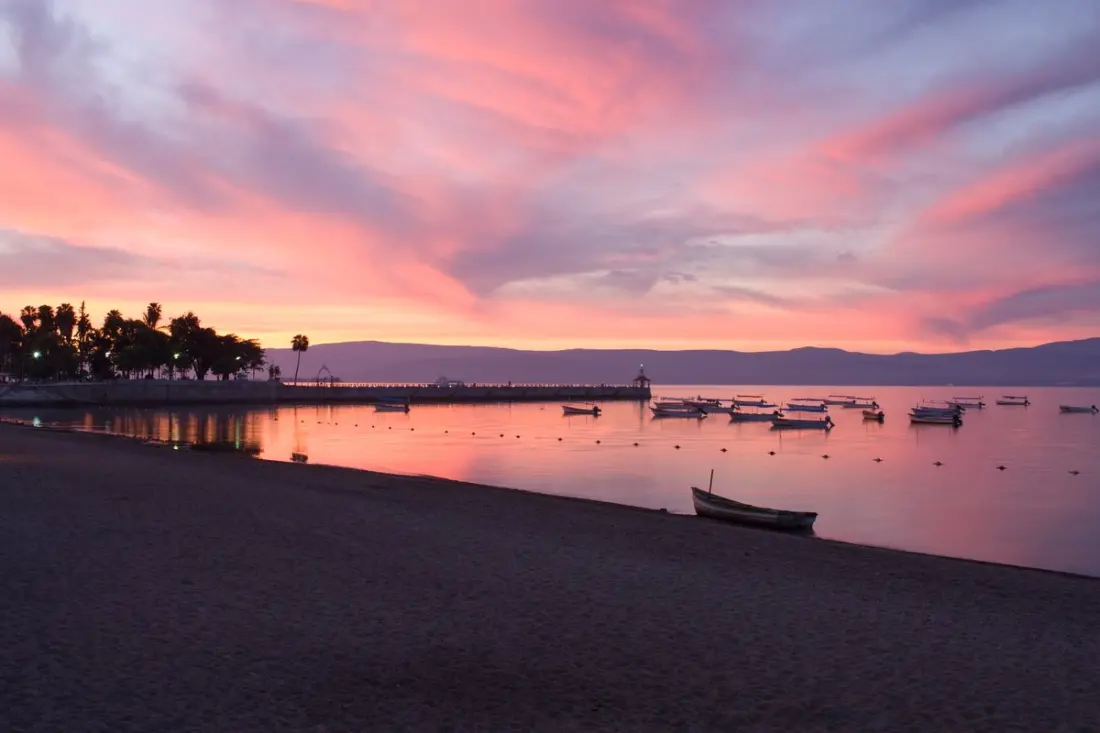
An hour south of Guadalajara, three small towns sit on the northern shore of Mexico's largest lake — Chapala, Ajijic and Jocotepec. Together they hold the biggest concentration of American and Canadian residents anywhere in Mexico, and for decades they've been the country's default answer to the question: where do I retire abroad?
Chapala is the first town you reach driving from Guadalajara and its international airport, about 30 minutes away. It's the transport hub, with the area's main bus station, a lakeside promenade, pier and cafés, plus boat trips to islands including Isla de los Alacranes. Guadalajarans flood in on weekends, so expect crowds on Saturdays and long holiday weekends.
Ajijic, 20-30 minutes further west, is the star. Cobbled streets, plazas and a tree-lined boardwalk give it the classic colonial-Mexico look, but alongside it you'll find English-speaking services, shops and restaurants. Street art and murals are everywhere — a tradition tracing back to a 1954 children's art programme at the Lake Chapala Society. Farther along the shore, Jocotepec ("Joco") has traditionally drawn fewer foreign residents, but rising prices in Ajijic and Chapala are pushing newcomers there for cheaper rents and a more Mexican feel, while highways 15 and 80 give quick access to southwest Guadalajara's big-box stores.
What makes the area work is depth of infrastructure. The Lake Chapala Society in Ajijic acts as the community's nerve centre, helping newcomers plug into events and services, while the Lakeside Little Theatre runs the cultural side. Saturday walking tours of Ajijic led by Greg Custer cover the town's history, culture and ecology. There are also dedicated orientation programmes for people weighing up a move.
The climate is a major draw. At around 1,525 metres elevation on a huge lake, winters are mild enough to skip heating (lows around 13C) and summers stay comfortable without air conditioning (daytime highs near 29C). The rainy season runs late May to October, and being inland, the area largely escapes hurricanes. Chapala itself has roughly 56,000 residents according to the 2020 census.
The honest caveat: this is one of the pricier corners of Mexico. Living here still costs less than the US, Canada or Europe, but relative to other Mexican expat hubs, expect to pay a premium for the convenience. And it's not for everyone — if you want deep immersion in Mexican daily life with few English speakers around, you'd look elsewhere. But if you want Mexico's climate, food and architecture with an instant Anglo community on your doorstep, plus a major international airport nearby for trips back to family or business, it's hard to beat. History buffs can claim bragging rights too: D.H. Lawrence wrote The Plumed Serpent while staying in Chapala, and former president Porfirio Díaz holidayed here.