Mogul runs chew up skiers who arrive at the resort with unprepared legs. The good news, according to Maddi Beck, a strength and conditioning coach for the U.S. Ski & Snowboard Team, is that while mogul skiing itself can only be learned on snow, the athletic qualities behind it can be built in the gym months before the lifts start spinning.
Beck breaks the physical demands into three buckets. First, trunk control: holding your torso steady while your legs bounce and change direction beneath you. That both keeps your skiing efficient and spares your lower back from absorbing the punishment of run after run through the bumps. Second, lower-body muscular endurance — quad stamina in particular — so you can string together multiple runs without your form collapsing. Third, the ability to absorb and rapidly redirect force, which is the essence of pivoting around mogul after mogul.
Her programming covers all three. For core work, two exercises make it into every plan she writes, even for Olympic medalists: dead bugs (lying on your back, extending opposite arm and leg while keeping your lower back glued to the floor, two sets of eight reps per side) and the Pallof press (a cable or banded anti-rotation hold at chest height, 20 seconds per side, two to three sets). Slot them into any workout as a warm-up or cooldown finisher.
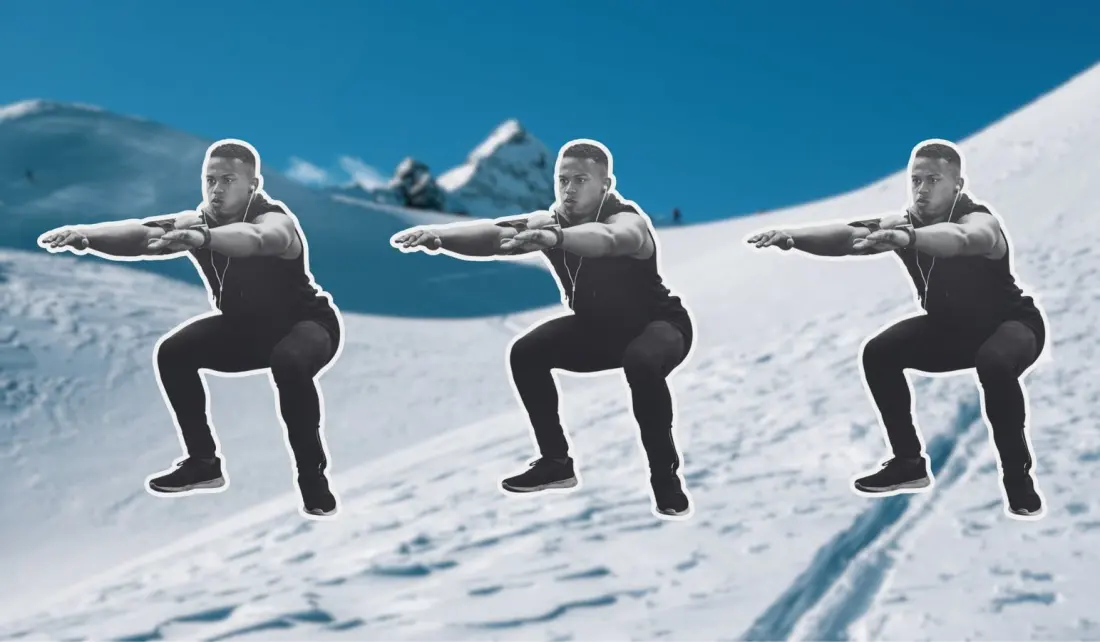
For leg endurance, Beck uses a three-move squat circuit: 30 seconds of bodyweight squats, 30 seconds of squat pulses (staying low and bouncing a few inches), then 30 seconds holding the bottom position. Run the three back-to-back with no rest, take 90 seconds off, and repeat for two rounds, once or twice a week. Progress by building to five rounds, adding squat jumps as a fourth move, or trimming the rest period.
For power, it's box jumps and depth jumps — two sets of three to five reps and two sets of two to three reps respectively, done twice a week early in the workout while your legs are fresh. Start on a low box around six inches and climb gradually, and opt for a soft box if your gym has one; catching a toe on a wooden one hurts. To keep progressing, Beck alternates soft and stiff landings, then shifts to single-leg variations before raising the height again.
The supporting cast matters too. Beck puts cardio near the top of the priority list — the national team trains it heavily because conditioning lets you ski bigger days with cleaner form, which in turn reduces injury risk. Her general advice: regular bike rides, hikes, or runs of 45 minutes or more. And don't skip hip and ankle mobility, since better range in those joints translates to better control of your skis and torso.
Who is this for? Any skier eyeing the bumped-up runs they usually avoid, or anyone heading to a mogul-heavy mountain who wants their quads to survive day two. Start this routine at least a couple of months before your trip and you'll feel the difference on the first steep, bumpy pitch — and still be able to walk on the third day.
Credit: Outside Online