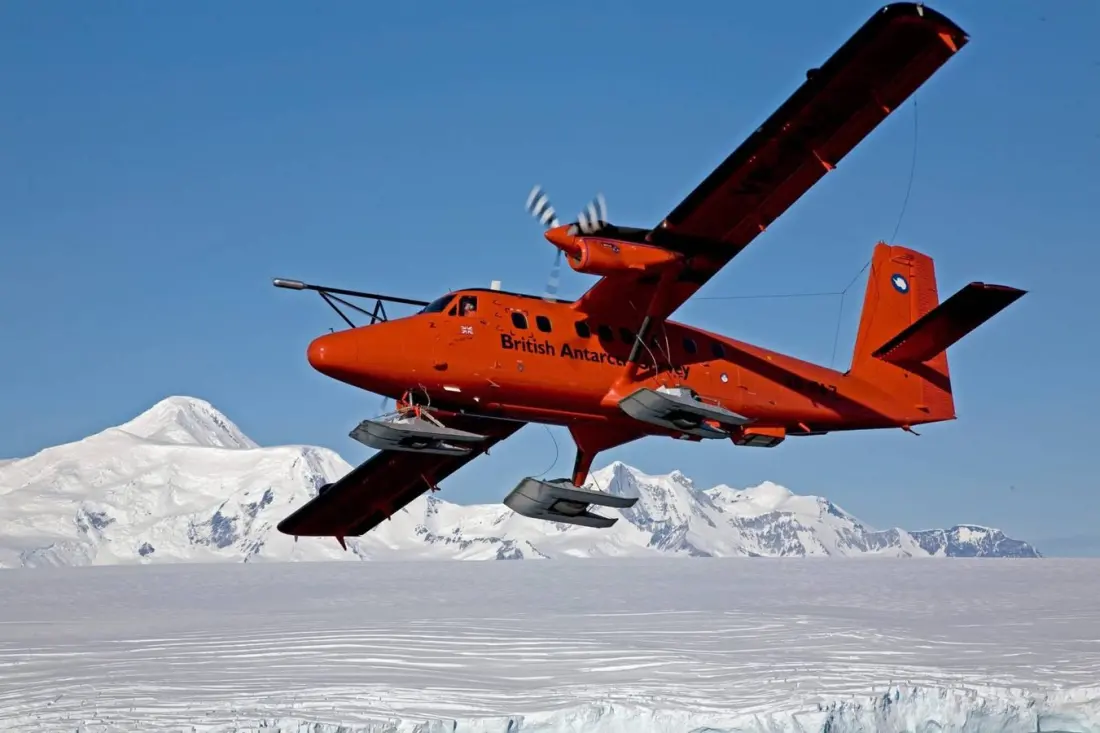
Every October, the British Antarctic Survey performs one of aviation's strangest rituals: flying a pair of small, decades-old utility aircraft from Calgary all the way to Antarctica. This year's journey covers 9,065 miles (14,588 km) and takes around 11 days, with roughly 53 hours in the air. The stars are two De Havilland Canada DHC-6 Twin Otters, VP-FBB (about 44 years old) and VP-FBL (around 38), registered and maintained in Canada ahead of each southern summer.
The trip isn't a nonstop dash. With modest range, the Twin Otters hop between whatever airports can handle them — tracked stops so far include Great Falls, Cheyenne, Amarillo, Houston, Cozumel and Panama, with a much longer and emptier South American leg still to come. Each stage is planned around fuel, weather and maintenance, since the airport network thins out dramatically the further south they go.
Why bother? Antarctic field operations run from October to March, when the austral summer brings enough daylight and tolerable conditions to fly. Once on the ice, the Twin Otters land on unprepared snow using wheel-and-ski gear, hauling scientists, fuel, food, snowmobiles, sledges and equipment to remote camps far from Rothera Research Station. They also double as flying labs, configured with ice-penetrating radar, gravimeters, magnetometers and laser scanners for airborne geophysics and climate research.
The Twin Otter's enduring appeal is the point. It's a rugged, high-wing turboprop with short takeoff and landing performance, able to run single-pilot and operate from runways, ice or water. Trans Maldivian Airways runs the world's biggest fleet — 67 aircraft, connecting over 80 resorts across 16 atolls as the largest seaplane operation anywhere. Canada's Kenn Borek Air, based in Calgary, uses them for polar, cargo and medevac work. And the type is still being built: De Havilland Canada delivered the 1,000th Twin Otter in March 2026 to Colombia's SATENA, with the new Classic 300-G variant now reaching operators like Switzerland's Zimex Aviation.
If you fancy following along, the aircraft are trackable in real time via the Simple Flying Flight Tracker — a rare chance to watch a slow, methodical crossing of two continents unfold airport by airport. It's a satisfying watch for anyone who loves old aircraft still doing exactly the job they were designed for.
Story via Simple Flying.